





No products available at the moment
Stay tuned! More products will be shown here as they are added.
Back to Home pageNew arrivals
On Sale
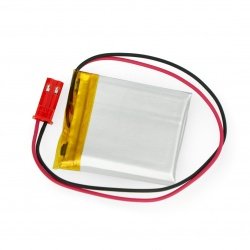
Lithium-polymer batteries are one of the most common energy sources used in robotics. They are characterized by high durability as well as safety of use. They have a long life, are adapted to recharge. Li-Pol batteries use polymer, thanks to which the risk of battery spillage is much lower than in lithium-ion batteries. Lithium-polymer batteries are used both in robotics and electronics. They are perfect for controlled devices, such as electric cars or airplanes, which are not only for the youngest. In our offer you will find a wide range of Li-Pol batteries, which are characterized by voltage up to 3.7 V to 14.8 V. They also have different capacities, so you can easily adapt them to your individual needs and design. We offer batteries with capacities from 110 mA up to 12000 mA. Compare the other parameters as well, so that you can choose the best option for yourself or even afford more for your new project.
Subcategories
Products
No products available at the moment
Stay tuned! More products will be shown here as they are added.
Back to Home pageSee also
Lithium-polymer batteries, thanks to the gel electrolyte, do not pose the risk of spillage . It is also easier to create any shapes tailored to the devices in which they are to be powered. Lithium polymer batteries are currently used in most mobile phones (and other portable devices) - they are the successor to the previously used NiMH batteries (nickel-metal hydride batteries). Li-Pol packages, compared to NiMH batteries of approximate size and weight, offer approximately twice the current capacity , and are more durable and more resistant to difficult external conditions.
Lithium polymer batteries require proper treatment to remain fully functional. One of the most important factors is the moment and method of charging and discharging the package. A single cell should not exceed a certain discharge value (3V) because it may be permanently damaged. In the case of packs (batteries with a larger number of cells), you need to control the discharge of each of them separately - for this purpose, you should use balancers that allow you to control the voltage on each cell separately (separate outputs for each cell). To ensure appropriate operating conditions for this type of batteries, you should use appropriate chargers with a special logic system, which most often charges the cells through the balancer socket (it ensures uniform charging of each cell in the pack). The battery is charged at the maximum current and increasing voltage, and when the maximum level is reached, the current is reduced (the maximum voltage on the battery does not mean it is fully charged). Li-Pol battery chargers are divided into mains and special modules .
Our offer includes packages with 1, 2, 3 or 4 cells (cells) . The output voltages are 3.7 V, 5.0 V, 7.4 V, 11.1 or 14.8 V (depending on the package), while the capacities depend on the size of the cells - 110 mAh, 150 mAh, 220 mAh, 250 mAh, 300 mAh, 320 mAh, 400 mAh, 450 mAh, 470 mAh, 500 mAh, 520 mAh, 550 mAh, 560 mAh, 600 mAh, 650 mAh, 700 mAh, 750 mAh, 800 mAh , 850 mAh, 900 mAh, 980 mAh, 1000 mAh, 1100 mAh, 1200 mAh, 1250 mAh, 1300 mAh, 1350 mAh, 1400 mAh, 1500 mAh, 1550 mAh, 1600 mAh, 1800 mAh, 2200 mAh, 23 00 mAh, 2500 mAh, 2600 mAh, 2700 mAh, 3000 mAh, 3200 mAh, 3300 mAh, 4000 mAh, 4400 mAh, 5000 mAh, 5200 mAh, 5300 mAh, 6000 mAh, 8000 mAh or 12000 mAh. Greater capacity is also associated with larger dimensions and weight of the battery - it ranges from 5 g to 415 g. Other dimensions also depend on the model: length is from 25 mm to 172 mm, height from 3 mm to 42 mm, and width from 11mm to 80mm. Manufacturers who make the batteries we offer include Akyga, Cellevia, Dualsky, Gens Ace, Goobay, GPX Extreme, Pi Supply, Redox and Tattu.
Special chargers designed for secondary cells of this type are used to charge lithium-polymer and lithium-ion batteries. The entire charging process is divided into cycles. The time necessary to replenish the energy in a lithium-polymer battery depends on several factors. The first is the battery capacity, the second is the charger's current efficiency, and the third is the discharge rate. The smaller the LiPo batteries (lower capacity), the faster the charging process will be compared to batteries with a much larger capacity (while maintaining the same parameters and charging conditions)
Using Li Ion batteries is not always effective. Success depends on several factors. The first one is the voltage level, the second one is the time the battery was left in a state of deep discharge. The best method (though with no guarantee of effectiveness) are special chargers for Li-Ion batteries , which enable precise setting of charging parameters.
Lithium polymer batteries are characterized by high resistance to a large number of charging and discharging cycles, which in practice means a very long life. Additionally, the lipo battery can be safely recharged, regardless of the current charge level. However, lithium polymer batteries are resistant to very deep discharge, which may damage them.