

Over 500,000 customers already trust us. With us you get:
same-day shipping for products marked “24h shipping”
our own service centre in Poland
30 days to return and free delivery in Poland from PLN 500
4.9/5 on TrustMate and 4.9/5 on Google (almost 4,000 reviews)
VAT invoice, leasing and instalments for businesses
For businesses
individual quote for larger quantities
VAT invoice
For schools and universities
orders based on requests for quotation
help with choosing kits for your lab

ADS1115 16-Bit ADC - 4 Channel with Programmable Gain Amplifier STEMMA QT/Qwiic- Adafruit 1085
The ADS1115 from Adafruit is a 16-bit ADC with 4 inputs, a PGA amplifier up to x16 and STEMMA QT connectors for connections without soldering.
- Up to 860 samples per second over I2C, 4 addresses from 0x48 to 0x4B
- Supply and logic from 2 V to 5.5 V, 150 µA consumption in continuous mode
- 2.54 mm pitch pin header strip included
We could not load the price.
The promotional price does not combine with quantity discounts.
ADS1115: a 16-bit ADC over I2C
ADS1115 is a 16-bit analog-to-digital converter with 4 inputs and a PGA amplifier up to x16, which on the Adafruit 1085 board you connect to a microcontroller over I2C. The chip performs up to 860 measurements per second and works as 4 single-ended channels or 2 differential channels, meaning channels that measure the voltage difference between two inputs.
The module is useful with boards that have no ADC of their own and wherever the microcontroller's built-in converter is not accurate enough. The manufacturer has prepared examples for Arduino, CircuitPython and Raspberry Pi, e.g. the Raspberry Pi 5. The power supply and logic work from 2 V to 5 V, so the board works with 3.3 V and 5 V devices. The STEMMA QT connectors on both sides are Qwiic compatible, so you can connect the module without soldering.

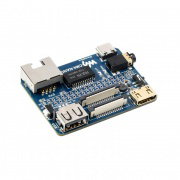
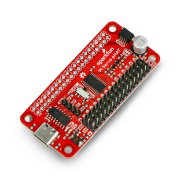
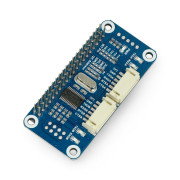
ADS1115 Adafruit 1085 module
16
bits of converter resolution
860
samples per second (max.)
4
analog inputs
x16
max. PGA gain

Botland is an official distributor of Adafruit electronics. These dependable American solutions cover sensors, controllers, Arduino shields, educational systems, smart building and a wide range of accessories. The Botland range holds original Adafruit products only.

ADS1115 Adafruit 1085 module
Pins and 4 I2C addresses
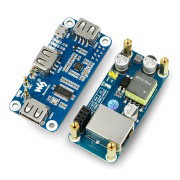
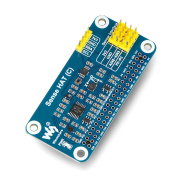
The board brings out the VIN power pin, the GND ground, the I2C lines SCL and SDA, the ADDR address select pin, the ALRT output and 4 analog inputs A0-A3 (on the ADS1115 chip: AIN0-AIN3). Ferrite beads on the board filter noise on the power and ground of the analog section, and 4 mounting holes make it easy to screw the module into an enclosure.
You connect the ADDR pin to GND, VDD, SDA or SCL and in this way select one of 4 addresses from 0x48 to 0x4B. So up to 4 such modules work on one 2-wire I2C bus, which gives up to 16 single-ended or 8 differential inputs. Through the STEMMA QT connectors you can attach other modules to the same bus, e.g. the MCP23017 STEMMA QT GPIO expander.
ADS1115 pinout: pins and functions
| Pin | Function |
|---|---|
| VIN | power supply from 2 V to 5 V (the same value as the microcontroller logic) |
| GND | ground |
| SCL | I2C bus clock |
| SDA | I2C bus data |
| ADDR | I2C address select |
| ALRT | comparator output or conversion ready signal |
| A0 | channel 1 input or the positive input of the differential pair A0-A1 |
| A1 | channel 2 input or the negative input of the differential pair A0-A1 |
| A2 | channel 3 input or the positive input of the differential pair A2-A3 |
| A3 | channel 4 input or the negative input of the differential pair A2-A3 |
ADS1115 I2C address by the ADDR pin
| ADDR connected to | 7-bit address |
|---|---|
| GND | 0x48 (1001000), default address |
| VDD | 0x49 (1001001) |
| SDA | 0x4A (1001010) |
| SCL | 0x4B (1001011) |
ADS1115 with Arduino, ESP32 and Raspberry Pi
Connecting to an Arduino takes 4 wires: SCL to SCL, SDA to SDA, GND to GND and the module power to 5 V. With 3.3 V boards, such as the ESP32 with the ESP-WROOM-32 module, you power the module from 3.3 V. In the STEMMA QT cable the SCL line is yellow, SDA blue, GND black and power red.
The Adafruit_ADS1X15 library for Arduino supports single-ended and differential measurements as well as the comparator, and uses the Wire library. The begin() function starts the converter at address 0x48, and begin(0x49) at the selected address. The manufacturer also provides Python and CircuitPython examples for the Raspberry Pi. For a breadboard, 20 cm jumper wires will come in handy.

ADS1115 Adafruit 1085 module

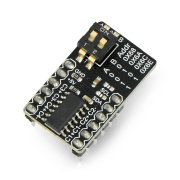
ADS1115 Adafruit 1085 module
PGA gain: a small signal across the full range
The PGA amplifier changes the converter's measurement range from ±6.144 V to ±0.256 V, so that a weak signal uses the whole 16-bit scale. At a gain of 2/3 (the default in the Adafruit library) one bit corresponds to 188 µV, and a sensor with an output of about 1 V is measured more accurately in the ±1.024 V range, that is at a gain of 4.
The ±6.144 V range describes only the converter's scale. The voltage on any input cannot exceed the supply voltage VDD by more than 0.3 V or fall more than 0.3 V below ground.
PGA gain ranges
| Gain | Measurement range |
|---|---|
| 2/3 (default in the Adafruit library) | ±6.144 V |
| 1 | ±4.096 V |
| 2 | ±2.048 V |
| 4 | ±1.024 V |
| 8 | ±0.512 V |
| 16 | ±0.256 V |
Is it a good choice for you?
A good choice if:
- you need accurate voltage measurement on a Raspberry Pi or Arduino over I2C
- you measure weak sensor signals and want to amplify them in software up to x16
- you want to chain several I2C modules in a STEMMA QT chain without soldering
Consider another option if:
- you need measurements faster than 860 samples per second on a single converter
- you directly measure voltages higher than the module's supply voltage
Fun fact
A chip smaller than a grain of rice
Texas Instruments makes the ADS1115 in a QFN-10 package measuring just 2 x 1.5 x 0.4 mm or in an MSOP-10 package. Such a tiny chip is hard to solder at home, so Adafruit mounts it on a 25.4 x 17.8 mm board with labeled pins.
Frequently asked questions
How do I connect the module to an Arduino?
Connect SCL to SCL, SDA to SDA, GND to GND and the module power to the Arduino 5 V pin. In your program use the Adafruit_ADS1X15 library and the readADC_SingleEnded() function to read a channel.
What I2C address does the ADS1115 have?
The default address is 0x48 with the ADDR pin connected to GND. Connecting ADDR to VDD, SDA or SCL sets the address to 0x49, 0x4A or 0x4B.
Can the ADS1115 measure 12 V?
Not directly. The voltage on an input can be at most 0.3 V higher than the VDD supply, which is from 2 V to 5.5 V, so 12 V must be reduced to this range before measurement.
How many modules on one bus?
Up to 4 modules, because the ADDR pin lets you set 4 different addresses. In total you then have 16 single-ended inputs or 8 differential pairs.
Kit contents
- 1 x ADS1115 module with 2 STEMMA QT connectors
- 1 x 2.54 mm pitch pin header strip to solder
Technical specifications
| Parameter | Value |
|---|---|
| Chip | ADS1115, Texas Instruments |
| Type | delta-sigma analog-to-digital converter |
| Resolution | 16 bit |
| Inputs | 4 single-ended or 2 differential |
| Sampling rate | 8-860 samples/s, programmable |
| PGA amplifier | from 2/3 to 16, ranges from ±6.144 V to ±0.256 V |
| Interface | I2C, modes up to 100 kHz, 400 kHz and 3.4 MHz |
| I2C address | 0x48-0x4B, selected with the ADDR pin |
| Supply and logic voltage | 2-5.5 V |
| Current consumption in continuous mode | 150 µA |
| Single-shot mode | automatic power-down after a measurement |
| Additional features | internal voltage reference, oscillator, comparator with ALERT/RDY output |
| Chip operating temperature | -40 °C to +125 °C |
| Connectors | 2 x STEMMA QT (Qwiic compatible), 2.54 mm pitch solder pads |
| Board dimensions | 25.4 x 17.8 x 4.6 mm |
| Manufacturer part number | Adafruit 1085 |
| Weight | 1.8 g |
Useful links
| Name | Value |
|---|---|
| Width | 7 cm |
| Height | 7 cm |
| Depth | 0.4 cm |
| Weight | 0.004 kg |
 GLS
Shipping in 24 hours
from €8.07
The full delivery terms are on the page Delivery and payment.
30 days to return, without giving a reason
If the product does not meet your expectations, you have 30 days from receiving the parcel to withdraw from the contract. The product only has to be complete. The right of return belongs to consumers (a purchase unrelated to business activity).
Complaints
If the product turns out to be faulty, you can make a claim under the guarantee or the statutory warranty. We handle claims without delay, at the latest within 14 working days of receiving the report together with the goods.
Be the first to ask a question about this product!
Instructions and documents
GPSR data
Product information
This product is a component intended for further assembly or prototyping. It is not a finished product within the meaning of the product safety regulations.
Products from the same category
See all