




















Pololu micro motors MP series - Medium Power is a category where you will find the highest quality electronics equipment. This series is characterized by a balance between equipment capabilities and power consumption. Pololu manufactures electric motors, mechanical parts for mobile robots, ready-made motor controllers and many other components used in robotics. Pololu products are characterized by high quality and high durability. Such results are achieved, among other things, thanks to high attention to detail and rigorous quality control at every stage of the devices' existence - from the first plans, through production, to customer feedback. The company offers extensive support to each customer - the latter receives detailed documentation (the so-called datasheet) and, in case of major problems, the possibility of direct contact with Polol engineers.
- Reduced price
- Sale
- Sale
- Sale
- Reduced price
- Sale
- Reduced price
- Sale

Pololu micro motors - MP series
See also
- 2-core cables
- 24v relays
- DJI Phantom drones
- Syma drones
- Zortrax Filaments
- Outdoor LED lighting
- Siemens LOGO!
- Esperanza compressed air
- 4-core cables
- Wireless mice
- Anet 3D printers
- DJI Mavic drones
- Conductive paint
- Power supplies 12v 10a
- Fluorescent filament
- DJI Inspire drones
- DJI Mavic drones - drones and accessories
- RPi Wi-Fi cards
- Magnetic balls
- Compressed air to clean the keyboard
- Car fuses
- Intel modules & kits
- Membrane keyboards
- Hexbug toys
- Tablets
- Encoders
- PLA Pro filaments
- Odroid cases
- Keyboards for Arduino
- Photo traps
- Banana Pi
- 2D printers and pens
- Intel starter kits
- Android Box Smart TV
- Raspberry Pi CM3
- GPS trackers
- Intel expansions & hats
- Smart ABS filaments
- Headphones
- Resistors SMD 1206
- Aqara - home automation
- Books about Raspberry Pi
- Chargers
- Dobot 3D printers
- Odroid accessories
- String bags (zip bags)
- Vacuum forming
- STM32 books
- Intel - module accessories
- Photon
- BCN3D 3D printers
- Electrolytic capacitors SMD
- AGM batteries
- Car handles
- Refill filaments
- BeagleBone power supply
- Sensors and alarms
- Alarm sirens
- Flsun 3D printers
- Tantalum capacitors SMD
- Doorbells and peepholes
- Motor capacitors
- RC cars and models
- Flexible filaments
- Khadas VIM
- Arylic sound modules
- Laminators
- Zortrax 3D printers
- Trilab 3D printers
- PowerBank mobile batteries
- Goofoo 3D printers
- Linear actuators
- Bluetooth Speakers
- Control equipment
- Webcams
- Urbicum 3D printers
- LED lighting
- Spare parts
- ATMAT 3D printers
- Weight meters
- TinkerGen
- Raspberry Pi 2B+
- Mycusini 3D printers
- DJI educational robots
- Makeblock 3D printers
- Fingerbot - home automation
- MakerPi 3D printers
- Transport cases
- Silk Filaments
- Orange Pi
- Sparky
- 3D printer Artillery
- Air conditioning and heating
- Abilix Krypton
- SkriWare - educational robots
- Gas soldering irons
- Air purifiers
- LittleBits
- Exta Free - sensors and modules
- USB Numato Lab GPIO drivers
- Rock Pi
- Spresense Sony
- Netronix RFID modules
- Clementoni
- AST lighting drivers
- CubieBoard
- WowWee
- Coolseer home automation
- AMK - automation and control
- Smartwatches
Pololu micro motors Medium Power - the universal solution
Pololu's micro Medium Power series motors are devices that offer a middle ground. It is a series of small motors which represents a compromise between economy and capability. The High Power series is based primarily on high capabilities such as high speed, high rpm and high power; choosing such equipment often requires a significantly reduced operating time or space for more energy storage cells. The Low Power series is intended to be as economical as possible while maintaining functionality; by using such devices, you can count on a much longer operating time per charge or significantly reduce the amount of space devoted to batteries, for example. Medium Power is the golden mean of both series. For students of technical universities who intend to purchase components to be used for many projects, this type of equipment is the most versatile.
What products do we offer in this category?
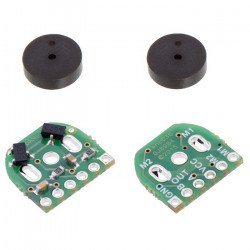
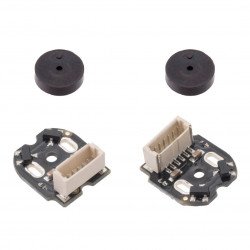
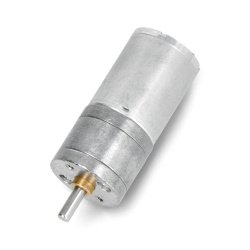
You will find a wide variety of different motors offered in this series. The choice should depend on what function they are to serve in a given project. It is worth to consider whether you care more about high speed (high speed of the rotating shaft) or high power of the device. For example, for a lightweight car model, high speed is better, while in a robotic arm, strength will be more important. These properties depend on the parameters of the gears used and the torque of the motor. A gearbox, for example, is able to reduce the speed of the shaft rotation, but increase the force at the same time. We have motors with gears of 5:1, 10:1, 30:1, 50:1, 75:1, 100:1, 150:1, 210:1, 250:1, 298:1. The different models have designated torques of 0.1 kg*cm, 0.2 kg*cm, 0.6 kg*cm, 0.9 kg*cm, 1.2 kg*cm, 1.4 kg*cm, 1.7 kg*cm, 2.6 kg*cm, 3 kg*cm or 3.3 kg*cm. These types of motors draw a relatively small amount of current when moving steadily with no load. Most models require about 40 mA for this purpose. It is worth noting, however, that this value can be, for example, 700 mA during motor start (this is the case of a motor with a gear ratio of 50:1 and a torque of 0.9 kg*cm). The models mentioned above offer acceleration capabilities of 75 rpm, 90 rpm, 100 rpm, 150 rpm, 170 rpm, 220 rpm, 290 rpm, 420 rpm, 730 rpm, 2200 rpm, and even 4400 rpm. In projects where micro motors are used, the best possible space organization often plays a very important role. The smallest possible components make this task easier and allow the size of the whole device to be reduced as much as possible. The Pololu MP micro motors offered in all models have the same diameter (12 mm), weight (10 g) and shaft diameter (3 mm). Note the varying length of the device between models; most are 24 mm, but we also have a few models with a length of 26 mm. It's worth noting that these "longer models" owe the two extra millimeters to the double-sided shaft - that's the extra end of the shaft on the other side of the motor that's connected directly to the other end. It allows the roboticist building the devices to mount an encoder on the extra piece, so he or she can keep track of the shaft's current speed and position. Such data makes intelligent feedback control possible, for example, so that motor speed can be smoothly controlled using an implemented PID controller.