



New arrivals


On Sale


Raspberry Pi CM4
Products







See also
Compute Module 4 - what is it?
The Compute Module (CM) series is a special version of the Raspberry Pi designed for industrial, embedded and commercial applications. A compact board with just the processor, RAM and, in some cases, eMMC memory. To use the Compute Module, you need to connect it to a carrier board, which provides the necessary interfaces. So why should you consider the Compute Module over the regular Raspberry Pi? The answer is simple. The Compute Module was created for companies and engineers who want to miniaturize their devices even further, create their own carrier boards instead of a pre-made system, and customize their hardware with the help of selected ports. In addition, the Raspberry Pi Foundation provides even longer support for the Compute Module than for the standard Pi models.
What's new in Compute Module 4 - specification
The mere fact that it’s based on the Raspberry Pi 4 means significantly higher performance, a new connector format, and optional wireless connectivity. Instead of the old SODIMM connector from the CM3+, the RPi CM4 uses two 100-pin connectors. The 1.5 GHz quad-core Broadcom BCM2711 Cortex-A72 processor is the same as the one in the Raspberry Pi 4 and is almost three times faster than the CM3+ processor. There are also more RAM options, optional Wi-Fi 5 and Bluetooth 5.0 on select models, USB 3.0 via the backplane, PCIe Gen 2 support for connecting NVMe SSDs, network cards, and other PCIe devices, two HDMI ports for supporting two 4K displays, and Gigabit Ethernet.
Raspberry Pi Baseboards for CM4
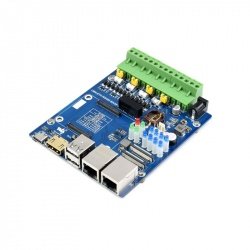
The Compute Module 4 (CM4) does not work standalone, as it lacks standard USB, HDMI, and GPIO ports. The appropriate interfaces are provided by the carrier board, the RPi base board. The official Raspberry Pi Foundation reference board, the Raspberry Pi CM4 IO Board, offers a full set of interfaces for testing and deploying the CM4. Popular third-party base boards include the Waveshare CM4 IO Base Board and its Full Version variant, or the Seeed Studio Dual Gigabit Ethernet Carrier Board for networks and routers. It is worth basing this choice on the intended use, the most common of which are science, prototyping, routers and networks, NAS servers, AI, robotics, IoT, and energy-efficient systems. For details, full specifications, and other useful information, visit the individual product pages on Botland.