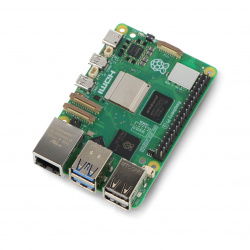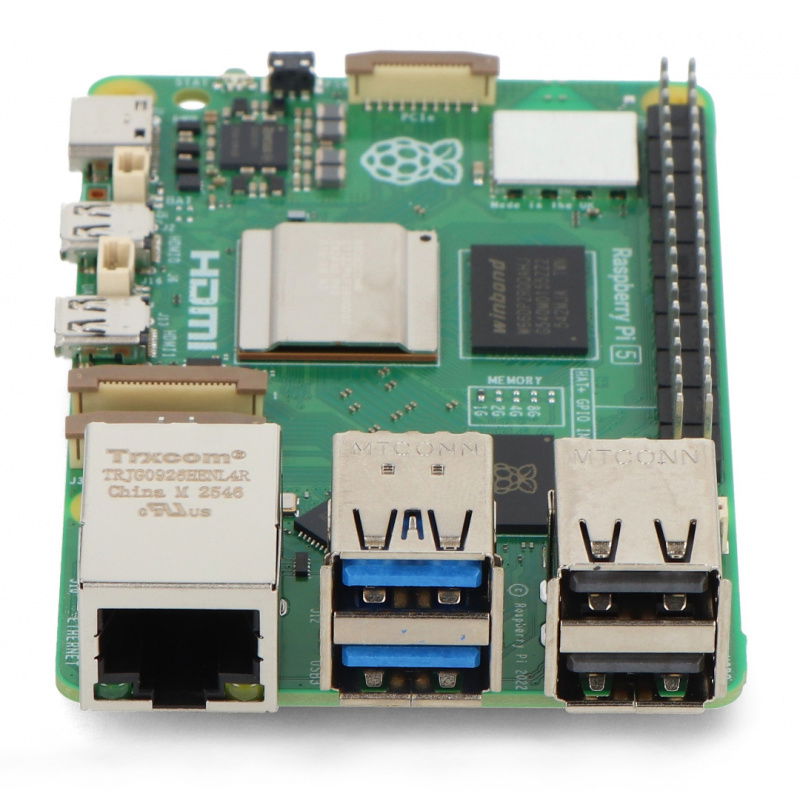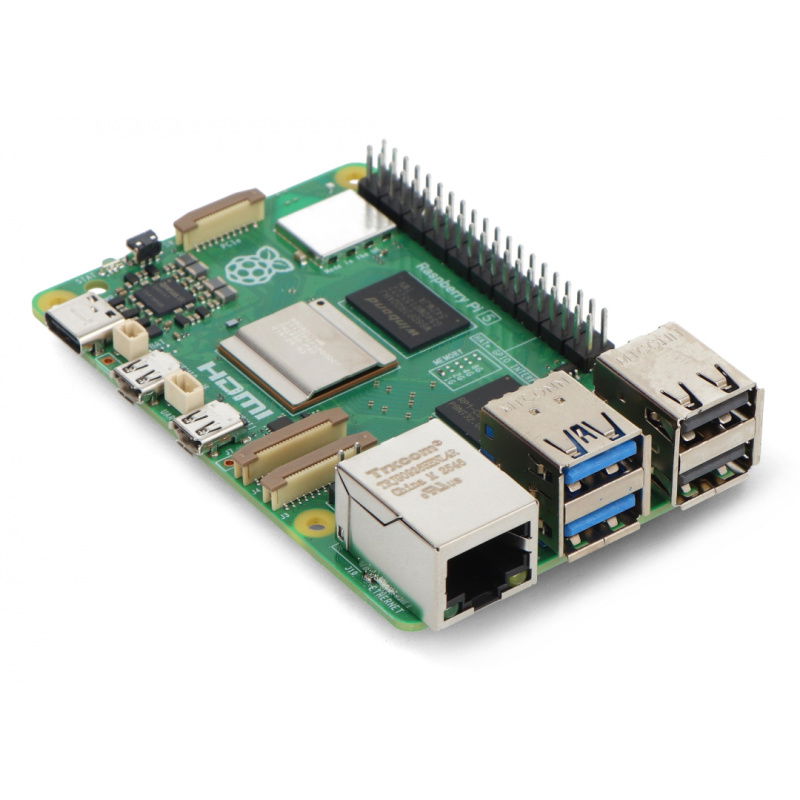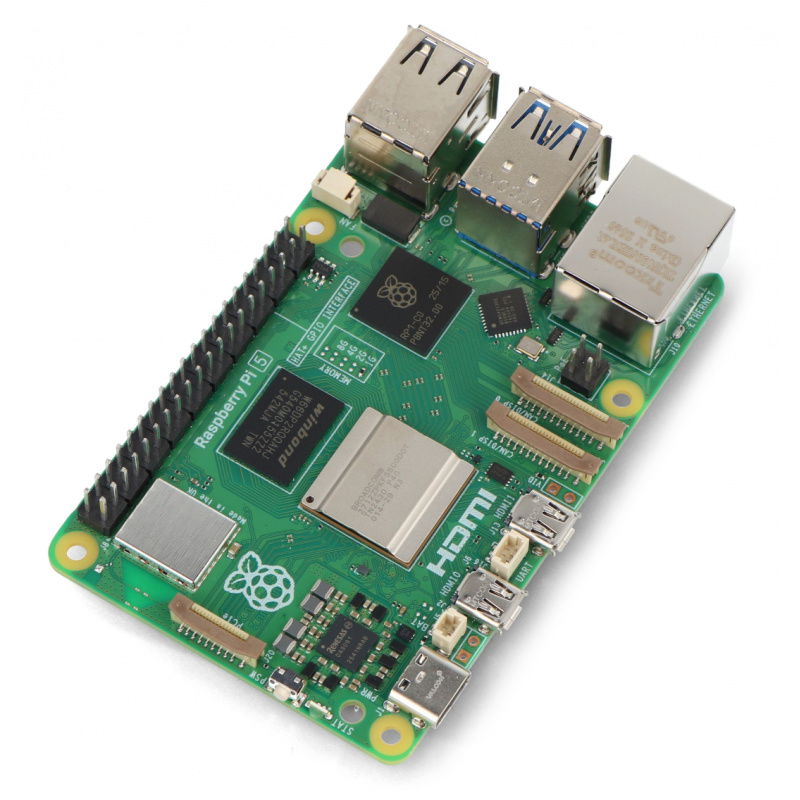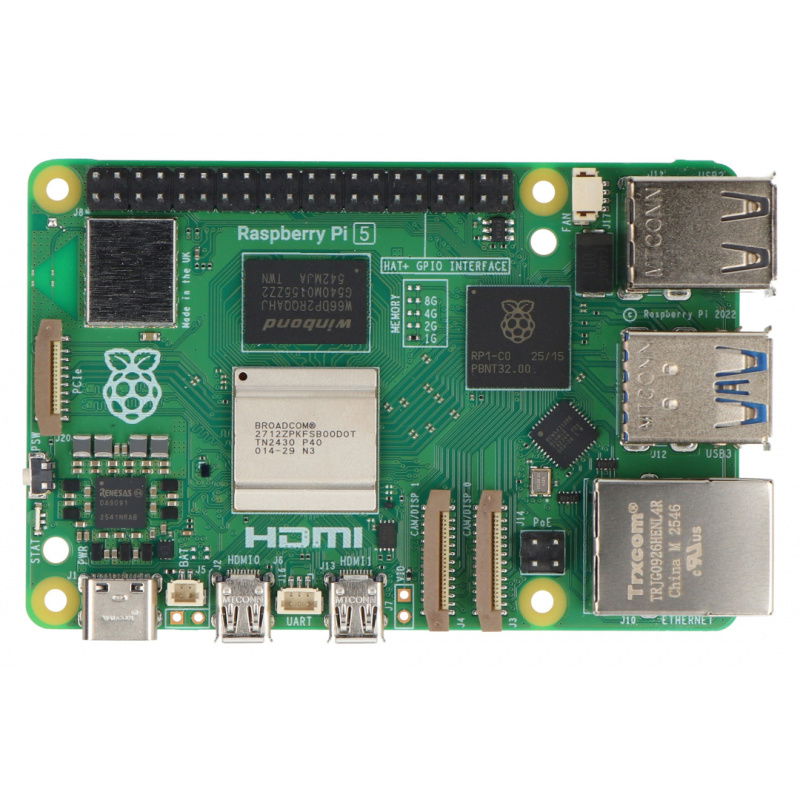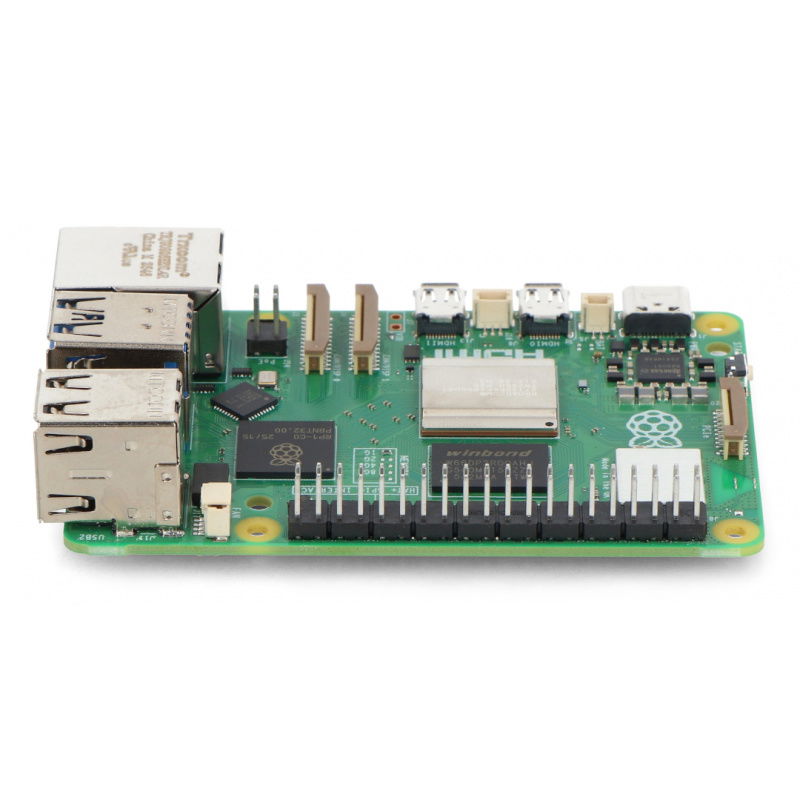





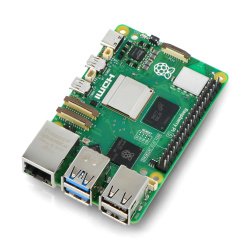
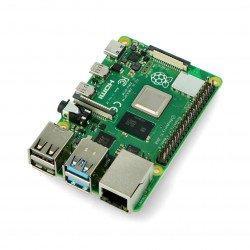



















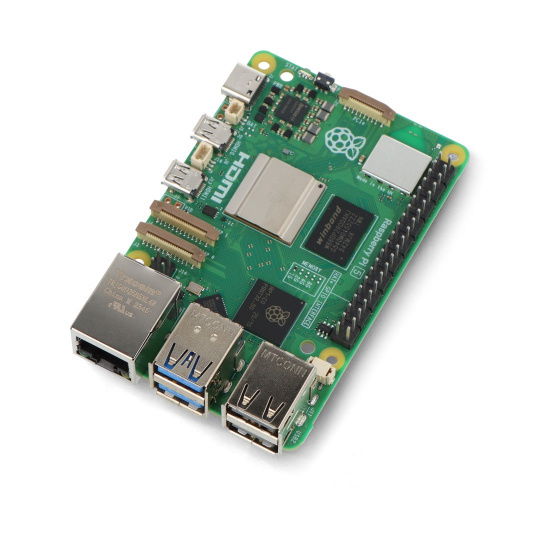
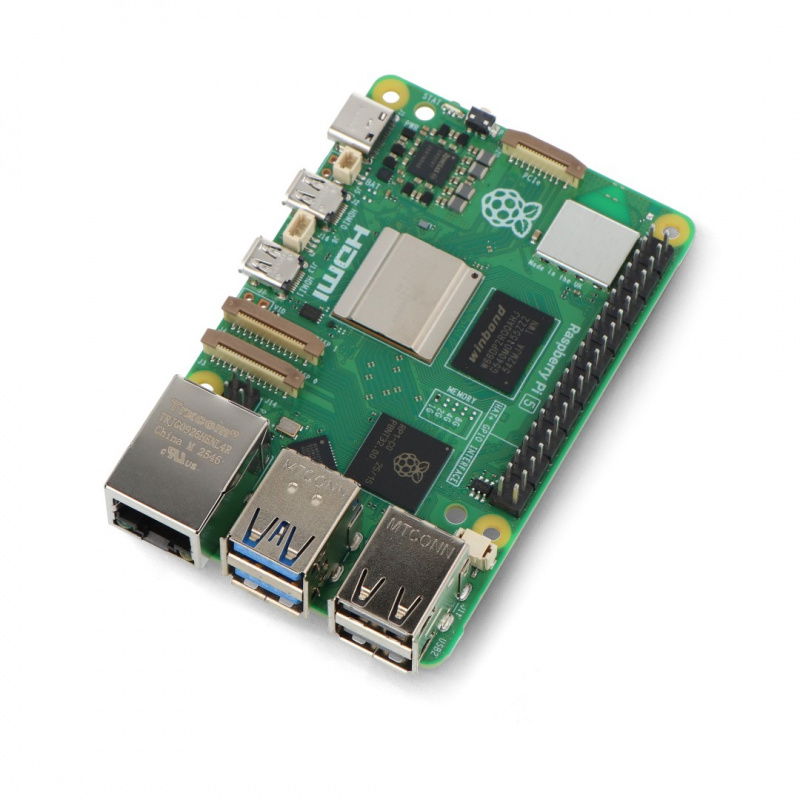


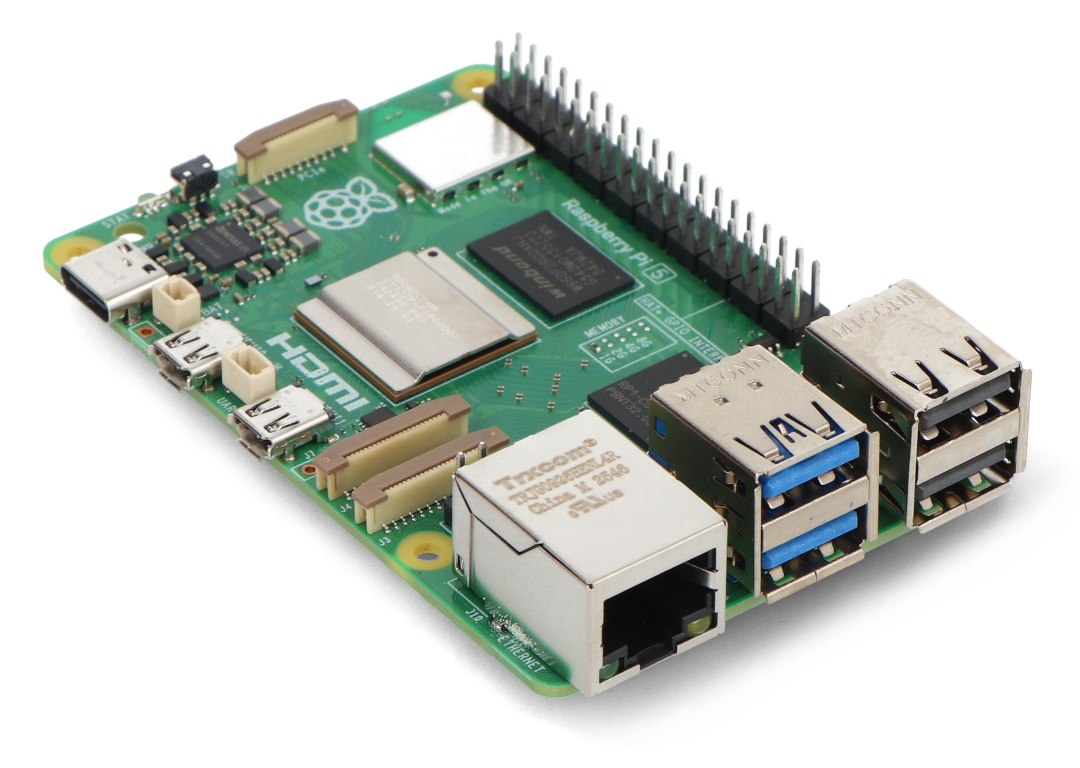
The Raspberry Pi 5 with 1 GB of RAM is the next generation of the iconic "Raspberry Pi" series. It features two microHDMI ports, two USB 3.0 ports, two USB 2.0 ports , and a USB Type-C power connector . The board is equipped with two MIPI DSI/CSI interfaces , a PCI Express 2.0 connector , a fan mount, a UART connector, an RTC battery socket, and a power button . Communication includes dual-band WiFi (2.4 GHz and 5 GHz), Bluetooth 5 BLE, and a gigabit Ethernet port with PoE support. This makes the Raspberry Pi 5 ideal for educational and hobby applications, as well as professional embedded systems and automation.
The Raspberry Pi 5 , equipped with 1 GB of LPDDR4X-4267 RAM , runs on a Broadcom BCM2712 ARM Cortex-A76 64-bit quad-core processor at 2.4 GHz . The fifth version of the popular Raspberry Pi offers performance that's up to 2-3 times faster than the Raspberry Pi 4. Standard equipment includes two microHDMI ports, two USB 3.0 ports , two USB 2.0 ports, and a USB-C power connector. Additionally, the Raspberry Pi 5 has two MIPI DSI / CSI interfaces for cameras and displays, a PCI Express 2.0 connector , space for a fan, a UART connector, an RTC battery socket, and a dedicated power button. The Raspberry Pi 5 also features dual-band WiFi (2.4 GHz and 5 GHz), Bluetooth 5 BLE, and a 1000 Mbps gigabit Ethernet port with PoE support using the PoE+ HAT . The board retains the standard 40-pin GPIO connector (2x20 pin, 2.54 mm pitch) and a microSD memory card slot that supports the operating system. In addition to the standard mounting holes, there's space for installing an official heatsink with a fan, further enhancing cooling capabilities during intense work.
Raspberry Pi 5 1GB.
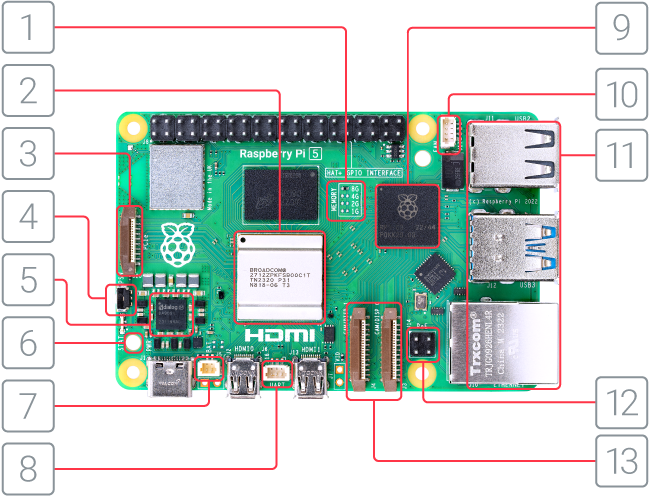
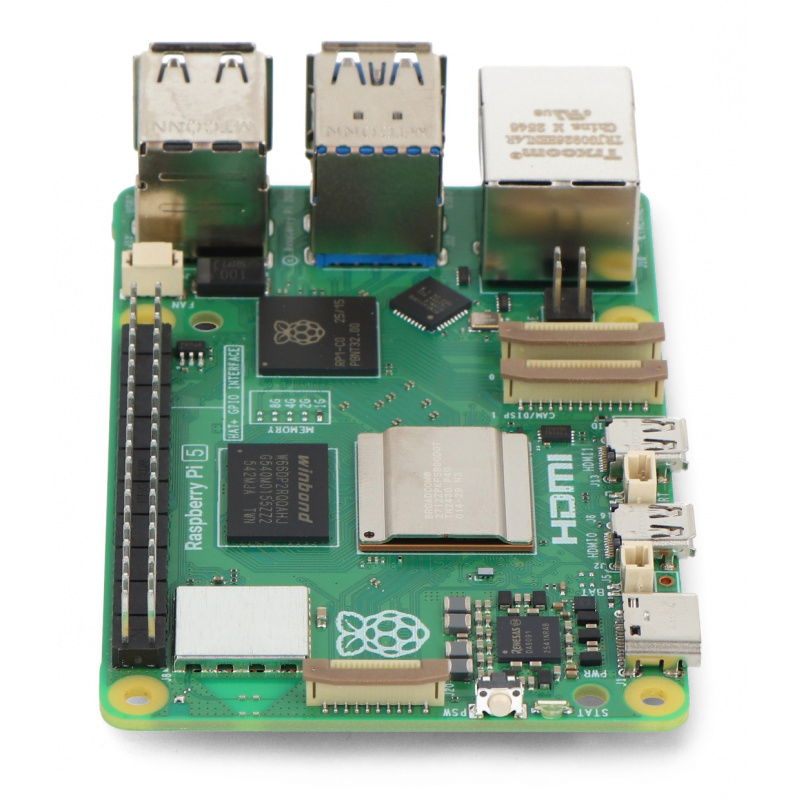
Layout of components in Raspberry Pi 5.
| Characteristic | Description |
|---|---|
| Several versions | Raspberry Pi 5 is available in several versions with different amounts of RAM: 1 GB, 2 GB, 4 GB, 8 GB, 16 GB. |
| BCM2712 processor | The Broadcom BMC2712 Quad-Core ARM Cortex-A76 64-bit chip, clocked at 2.4 GHz, is 60% faster than its predecessor. |
| PCIe 2.0 connector | The fifth version of Raspberry Pi is equipped with a fast PCI Express 2.0 connector, allowing you to connect peripherals with fast data transfer. |
| RTC battery connector | A dedicated connector allows you to connect a real-time clock (RTC) battery to maintain the current date and time. |
| UART connector | There is a UART connector on the board to which you can connect a debugger. |
| Two CSI/DSI connectors | Raspberry Pi 5 is equipped with two 4-line MIPI CSI / DSI connectors in mini 22-pin format with a 0.5 mm pitch, to which you can connect a camera and a display or two cameras / two displays. |
| ON/OFF button | The Raspberry Pi can now be turned on and off using the power button. The button can also be used to wake the Raspberry Pi from deep sleep mode. Holding the button for a long time cuts power to the minicomputer. |
| Raspberry Pi RP1 system | The RP1 chip was designed specifically by the Raspberry Pi Foundation to handle I/O interfaces, offloading the main processor from the minicomputer, making the Raspberry Pi 5 significantly more efficient than its older predecessors. |
| Distribution of connectors | The board outline remains the same as in previous versions, but the layout of the interfaces has changed. |
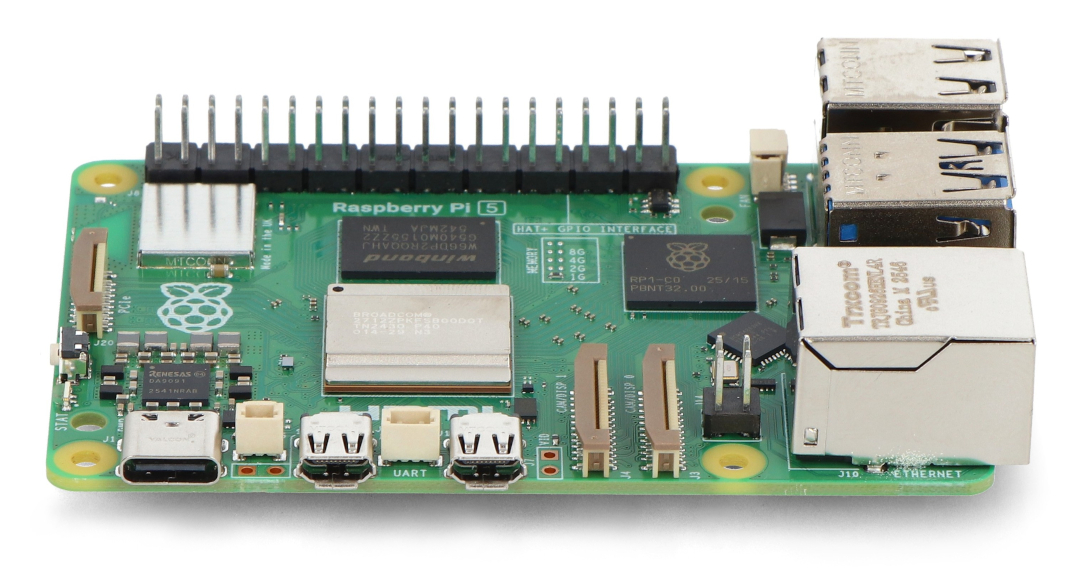
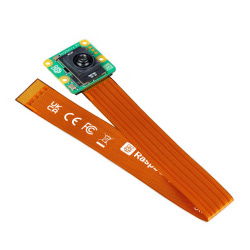
The board has two interfaces for the camera and MIPI DSI / CSI display.
The Raspberry Pi 5 delivers advanced multimedia capabilities thanks to two microHDMI ports , which enable 4K video and audio transmission at a smooth 60 frames per second. Additionally, the device has two 4-lane MIPI CSI/DSI ports , allowing you to connect two 4K displays or two cameras. The Raspberry Pi 5 utilizes the modern VideoCore VII GPU clocked at 800 MHz, guaranteeing performance when running advanced graphics and multimedia applications. The CSI/DSI ports, with 22 lanes and a 0.5mm pitch, require adapters if you plan to use earlier accessories.
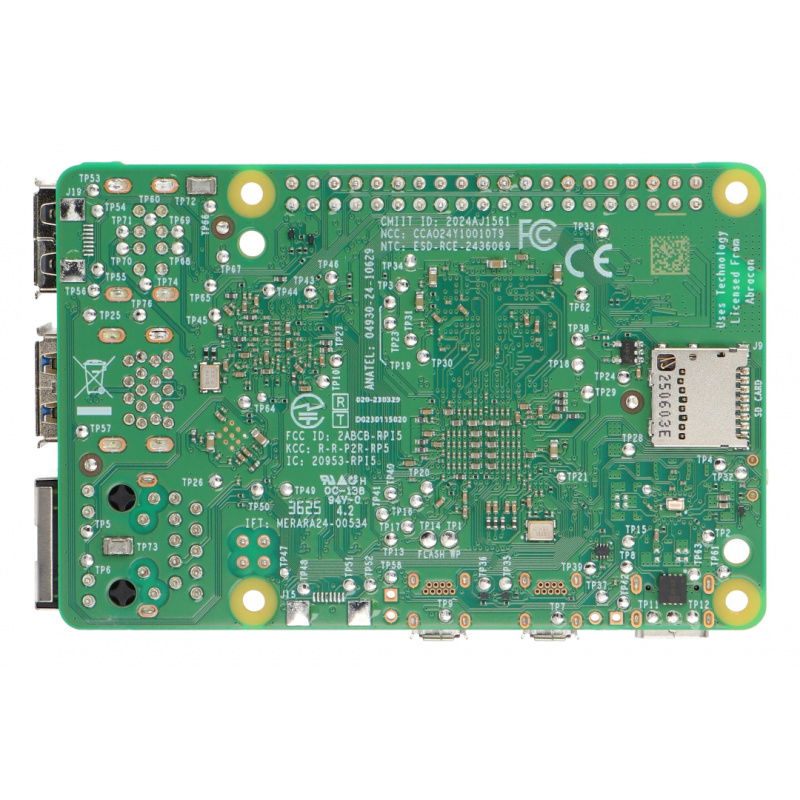
The Raspberry Pi 5 features a microSD card slot with high-speed SDR104 support, enabling rapid booting of the Raspberry Pi OS . Alternatively, the operating system can be run directly from the USB port. Our store offers memory cards with the operating system preinstalled, ready to use right out of the box. The Raspberry Pi 5 is fully compatible with Raspberry Pi OS, starting with the Bookworm version.
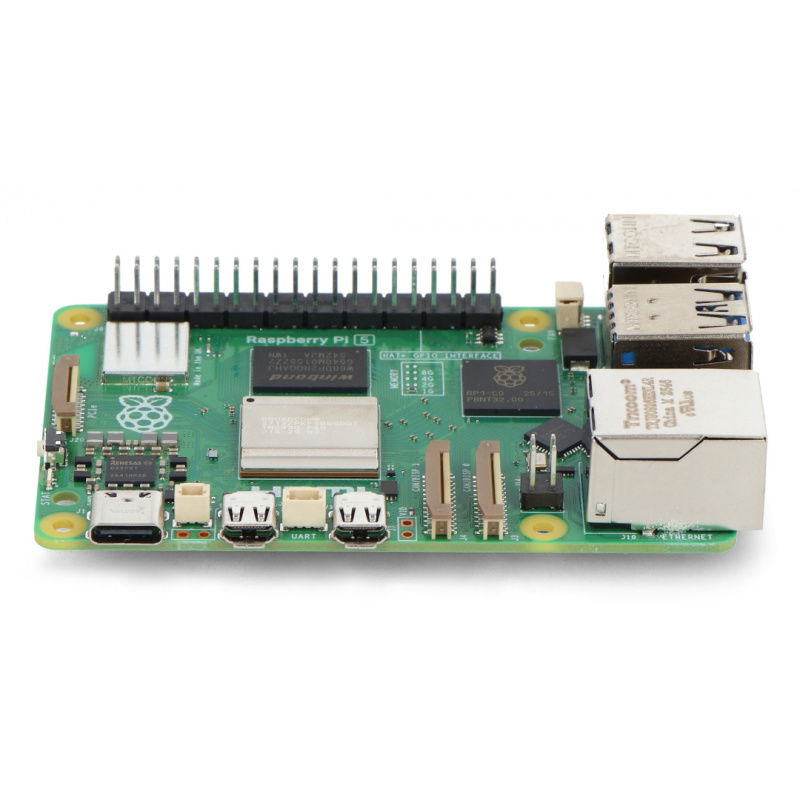
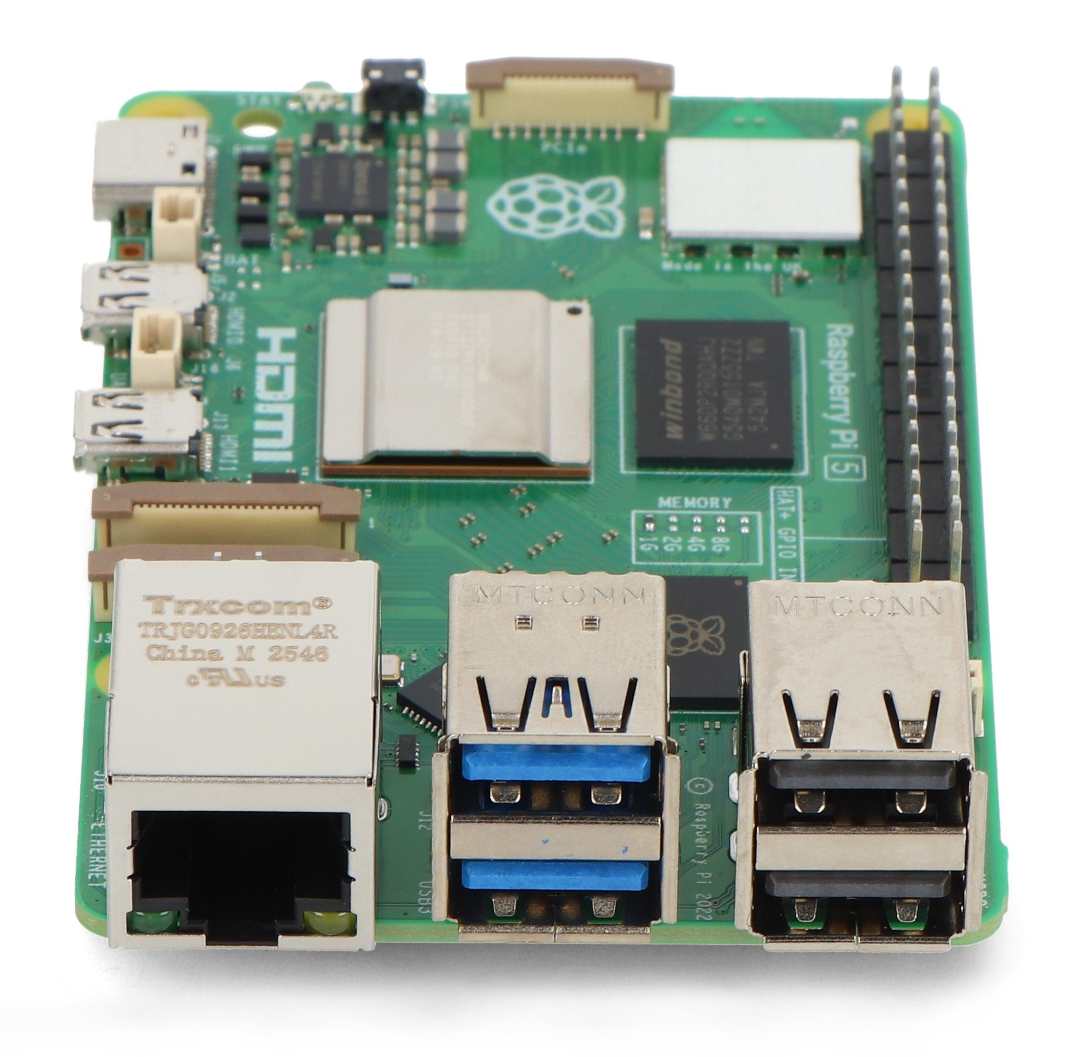 Interfaces on Raspberry Pi 5.
The fifth version of the Raspberry Pi retains the popular interfaces found on typical PCs. Key features include:
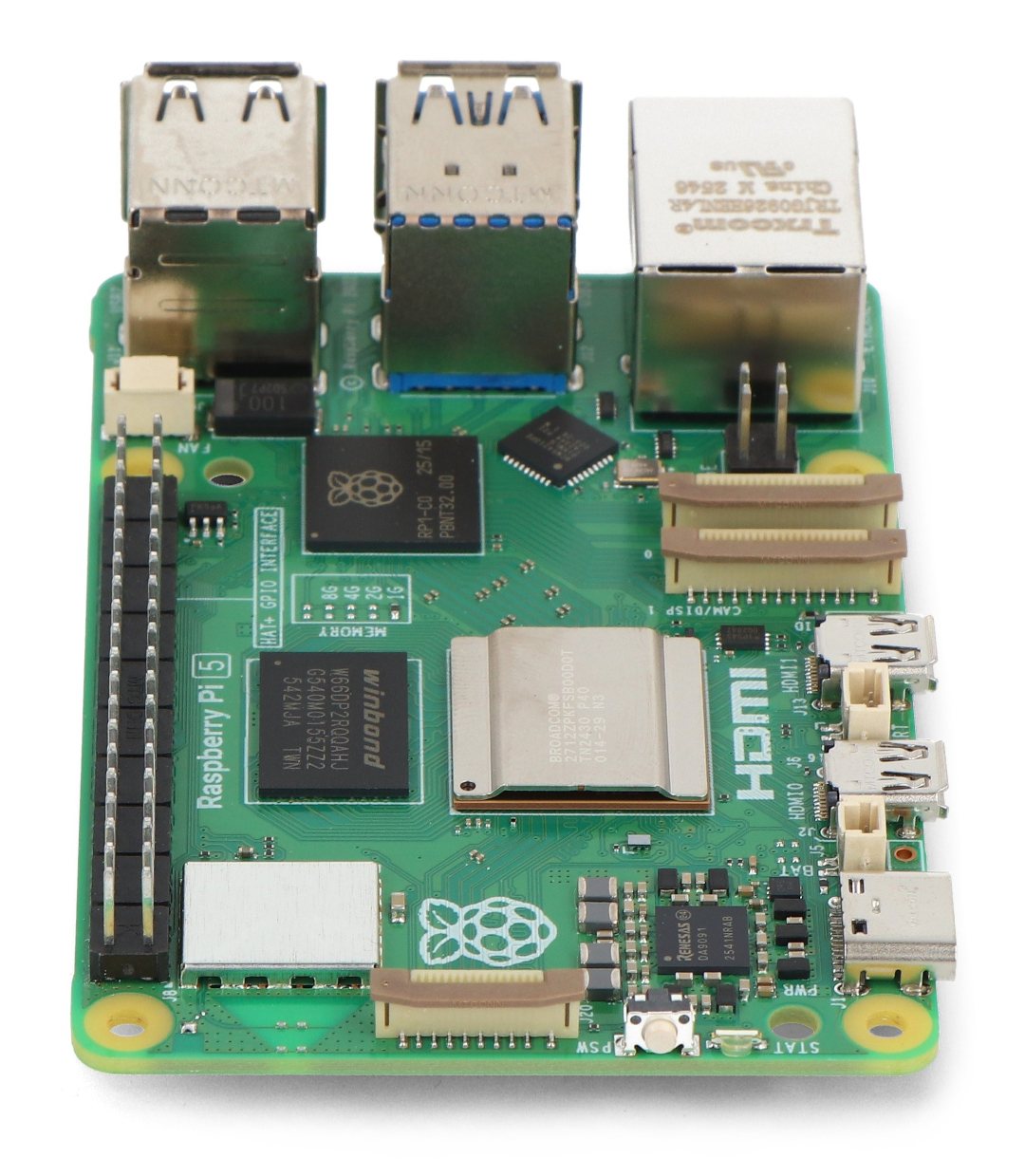 GPIO consists of 40 general purpose input/output pins.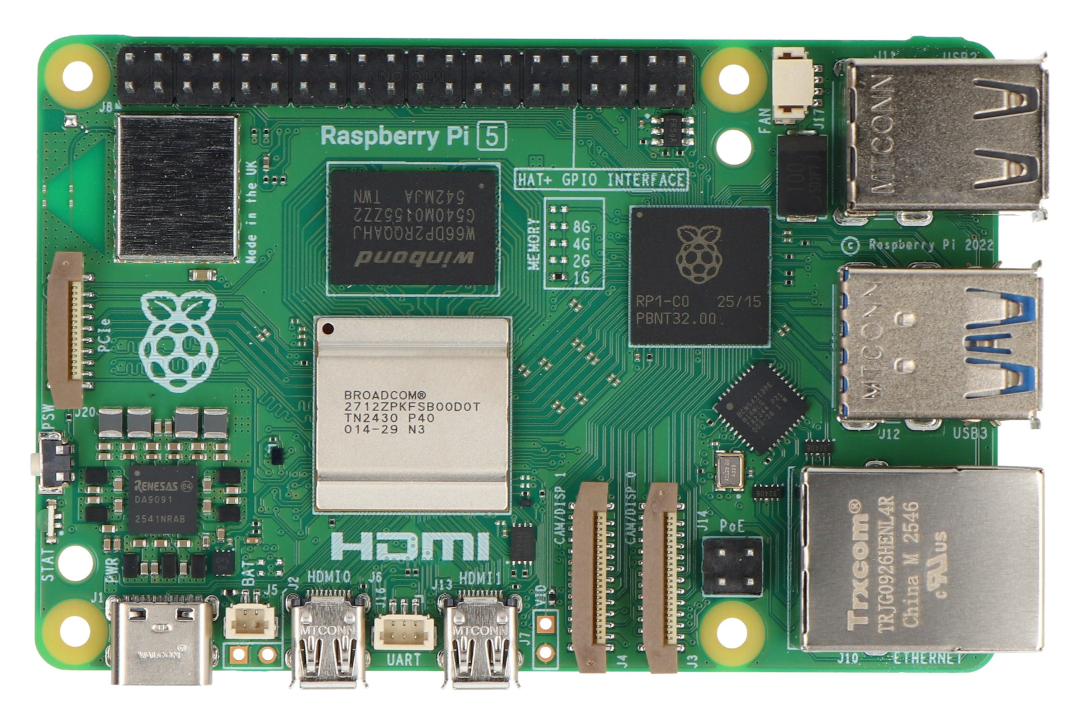
The Raspberry Pi 5 has a USB Type-C port designed to power the device.
The Raspberry Pi 5 uses a USB Type-C port as its power source. The device requires a power supply with a voltage of 5V and a minimum current output of 5A . We offer both original power supplies and high-quality replacements that are fully compatible with the Raspberry Pi 5. The standard current output of USB ports is 600mA . However, when a USB Type-C power supply supporting Power Delivery is detected, this limit automatically increases to 1.6A , allowing it to power more demanding peripherals.
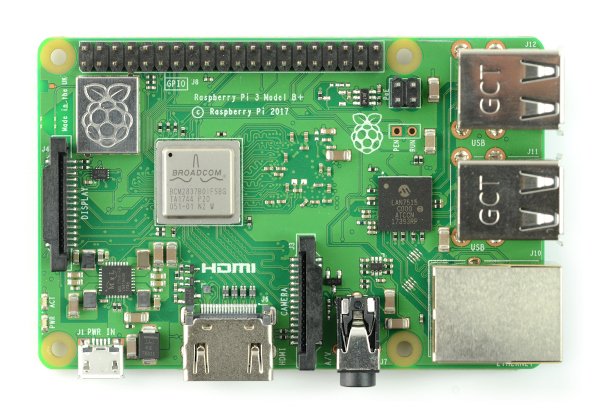 |  | 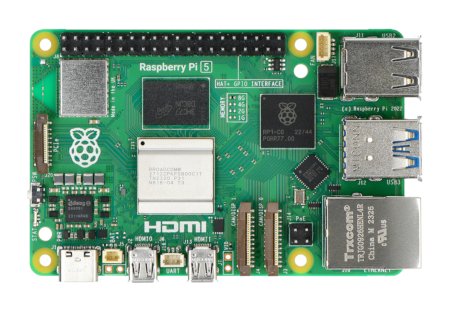 | |
| Model | Raspberry Pi 3 model B+ | Raspberry Pi 4 model B | Raspberry Pi 5 |
| Issue | 3 - 2018 | 6 - 2019 | 9 - 2023 |
| Chipset processor | Broadcom BCM2837B0 64-bit | Broadcom BCM2711 64-bit | Broadcom BCM2712 64-bit |
| Core | Quad-Core ARM Cortex-A53 | Quad-Core ARM Cortex-A72 | Quad-Core ARM Cortex-A76 |
| Operating systems | Raspberry Pi OS Windows 10 loT | Raspberry Pi OS | Raspberry Pi OS |
| Clocking | 1.4 GHz | 1.5 GHz | 2.4 GHz |
| Architecture | ARMv8-A | ARMv8-A | ARMv8-A |
| RAM | 1GB LPDDR2 @ 900MHz | Several versions
| Several versions
|
| Memory | microSD card | microSD card | microSD card |
| GPIO socket | 40-pin connector (2x20 pin) 2.54 mm raster | 40-pin connector (2x20 pin) 2.54 mm raster | 40-pin connector (2x20 pin) 2.54 mm raster |
| Power supply |
|
|
|
| Tile dimensions | 85 x 56 x 17 mm | 85 x 56 x 17 mm | 85 x 56 x 17 mm |
| USB interface | 4x USB 2.0 - type A socket | 2x USB 2.0 - type A socket 2x USB 3.0 - type A socket | 2x USB 2.0 - type A socket 2x USB 3.0 - type A socket |
| Network interface | 300 Mbps Ethernet port | 100/1000 Mbps Ethernet port | 100/1000 Mbps Ethernet port |
| WiFi interface | Dual Band 2.4 GHz and 5 GHz 802.11 b/g/n/ac | Dual Band 2.4 GHz and 5 GHz 802.11 b/g/n/ac | Dual Band 2.4 GHz and 5 GHz 802.11 b/g/n/ac |
| Bluetooth | Low Energy, BLE 4.2 | Low Energy, BLE 5 | Low Energy, BLE 5 |
| Camera | CSI nest | CSI nest | 2x 4-lane MIPI CSI/DSI socket |
| Touchscreen display | DSI socket | DSI socket | 2x 4-lane MIPI CSI/DSI socket |
| Video | HDMI HD 1080px / 30fps H.264 1080p30 OpenGLES 1.1, 2.0 | 2 x microHDMI H.265 4K 60 fps H.264 1080p 30 fps OpenGLES 1.1, 2.0, 3.0 | 2 x microHDMI H.265 4K 60 fps H.264 1080p 30 fps OpenGLES 1.1, 2.0, 3.0 |
| Communication | UART, SPI, I2C, GPIO | UART, SPI, I2C, GPIO | UART, SPI, I2C, GPIO |
| UC - Microcontroller | BCM2712 |
| UC - Core | Cortex A76 |
| UC - RAM | 1 GB |
| UC - core | 4. Quad Core |
| UC - Digital pins | 40 |
| UC - External memory | microSD card |
| UC - freq | 2.4 GHz |
| UC - Ethernet | yes |
| UC - WiFi | yes |
| UC - USB | 2x USB 3.0 + 2x USB 2.0 |
| UC - microSD | yes |
| UC - Bluetooth | yes |
| UC - HDMI | yes |
| UC - I2C | yes |
| UC - UART | yes |
| UC - Connector | USB typ C |
| UC - SPI interface | yes |
| UC - LCD interface | yes |
| UC - Camera interface | yes |
| UC - Linux | yes |
| UC - Android | no |
| Niebezpieczne | Equipment |
| Package width | 9.5 cm |
| Package height | 6 cm |
| Package depth | 2.5 cm |
| Package weight | 0.053 kg |
Be the first to ask a question about this product!