

































































Mechanical engineering is a field where precision and accuracy are of paramount importance. Incorrectly fitting individual components together may not only provoke unwanted vibrations, but also lead to faster wear of components or even their complete failure. A good illustration of this phenomenon may be the problems with the transmission of power from the motor shaft to the cooperating with it drive wheels, gears or other rotating elements, as well as the connection of encoders with motor shafts. In this category you will find various types of adapters for motors, used for convenient and reliable connection of drives with any other mechanical elements.

- Reduced price
- Sale

- Reduced price
- Sale
- Sale
- Sale

Adapters for motors
Products: 19
Loading...
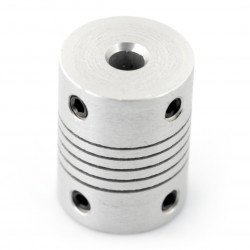
The flexible connector made of aluminum. The structure is made from a single piece of material, it becomes elastic by removal of material, forming a spiral track. Hole...
Index: GRL-12525
Index: GRL-12525
- Sale
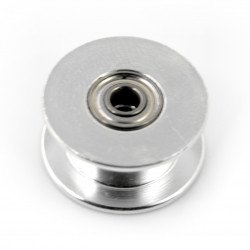
Pulley with Bearing - 18x8x3mm
Aluminum pulley with bearing. Diameter: 18 mm, height: 8 mm, hole diameter: 3 mm.
Index: GRL-12581
Index: GRL-12581
- Sale
- SPECIAL OFFERS
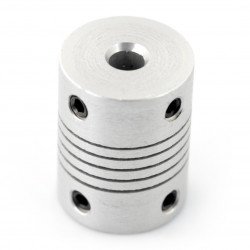
The flexible connector is made of aluminum. The structure is made from a single piece of material, it becomes elastic by removal of the material, forming a spiral track. Holes...
Index: GRL-12583
Index: GRL-12583
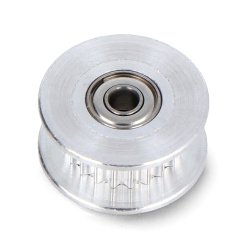
Aluminum gear with 20 teeth. Diameter: 18 mm, height: 8,5 mm, hole diameter: 3 mm.
Index: GRL-12578
Index: GRL-12578
- Sale
- SPECIAL OFFERS
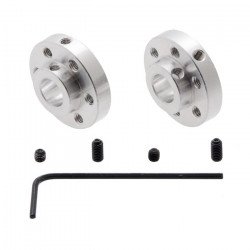
Aluminium Mounting Hub 8mm M3 - 2pcs. - Pololu 2693
Hub makes it easy to mount the wheel on the motor with the shaft of 8 mm using the M3 screws. The set has two pieces.
Index: PLL-09611
Index: PLL-09611
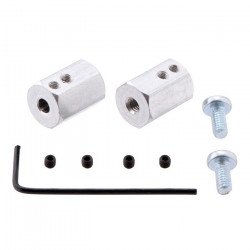
Hexagonal Wheel Adapter - 12mm/4mm - 2pcs. - Pololu 2684
Aluminum adapter converting the 12 mm, hexagonal shaft suitable for different wheels, for 3 mm motor's shaft. The length of the adapter is equal to 17 mm.
Index: PLL-06090
Index: PLL-06090
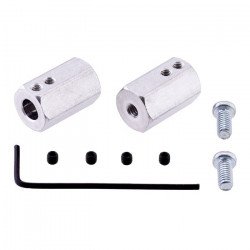
Extended Hexagonal Wheel Adapter - 12mm/6mm - 2pcs. - Pololu 2687
Aluminum adapter converting the 12 mm, hexagonal shaft suitable for different wheels, for 6 mm motor's shaft. The length of the adapter is equal to 35 mm.
Index: PLL-06093
Index: PLL-06093
Rubber V-belt - 2x90mm -10pcs.
Rubber belt used to transfer the drive e.g. from the motor shaft to another module, the thickness of the belt is 2 mm, the diameter is 90 mm. The set contains 10 pcs of belts.
Index: GRL-12513
Index: GRL-12513
- Sale
- SPECIAL OFFERS
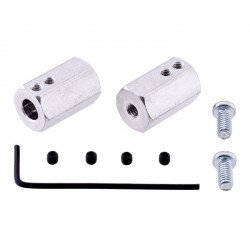
Hexagonal Wheel Adapter - 12mm/6mm - 2pcs. - Pololu 2686
Aluminum adapter converting the 12 mm, hexagonal shaft suitable for different wheels, for 6 mm motor's shaft. The length of the adapter is equal to 20 mm.
Index: PLL-06092
Index: PLL-06092
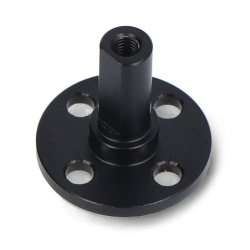
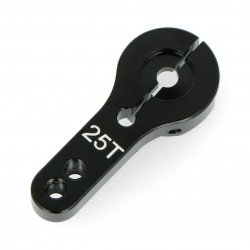
Metal Flat Key Shaft Flange Plate-A wheel adapter for servos - black - Waveshare 24985
Adapter from Waveshare intended for use with servomechanisms . It enables easy and quick construction of a drive based on a servomechanism controlled via a serial bus.
Index: WSR-23727
Index: WSR-23727
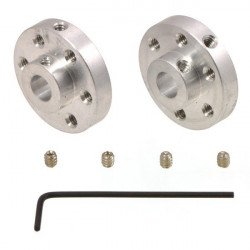
Aluminium Mounting Hub 6mm M3 - 2pcs. - Pololu 1999
Hub makes it easy to mount the wheel on the motor with the shaft of 6 mm using the M3 screws. The set has two pieces.
Index: PLL-01838
Index: PLL-01838
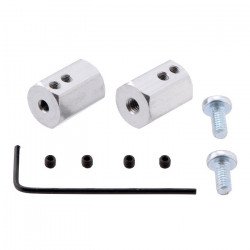
Hexagonal Wheel Adapter - 12mm/3mm - 2pcs. - Pololu 2682
Aluminum adapter converting the 12 mm, hexagonal shaft suitable for different wheels, for 3 mm motor's shaft. The length of the adapter is equal to 17 mm.
Index: PLL-06091
Index: PLL-06091
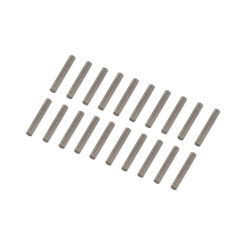
Set of 20 pieces of shafts with the length of 20 mm and a diameter of 3 mm.
Index: GRL-12519
Index: GRL-12519
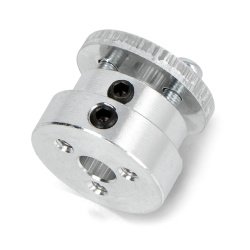
Aluminum wheel adapter 6mm M3 - Pololu 2674
Two-piece aluminum adapter for easy mounting of the wheel to a motor with a shaft diameter of 6 mm . The kit includes a threaded mount and a washer. The adapter is mounted to...
Index: PLL-22704
Index: PLL-22704
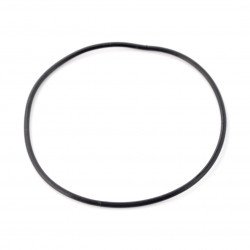
Rubber V-belt - 2x70mm - 10pcs.
Rubber strap is used to moving the drive, for example, from the motor's shaft to another module, the thickness of the strap is 2 mm and diameter is 70 mm. The set...
Index: GRL-12557
Index: GRL-12557
- Discontinued product
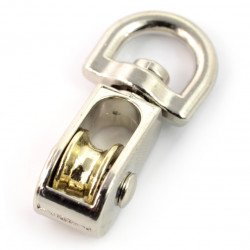
Hanging single Pulley - 7x14mm
Double, pendant, metal pulley with the width of 7 mm and a diameter of 14 mm. The Wheel can rotate 360 °. Dimensions of the whole: 44 x 14 x 13 mm.
Index: GRL-12573
Index: GRL-12573
- Discontinued product
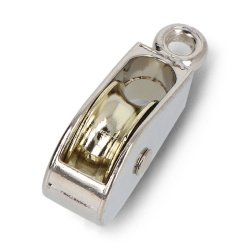
Double, pendant, metal pulley with the width of 10 mm and a diameter of 24 mm. The wheel can rotate 360 °. The sizes of the whole is: 53 x 25 x 15 mm.
Index: GRL-12515
Index: GRL-12515
- Discontinued product
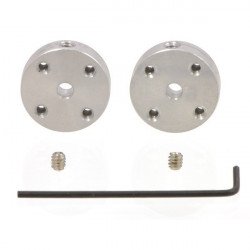
Aluminium Mounting Hub 3mm M3 - 2pcs. - Pololu 1996
Hub makes it easy to mount the wheel on the engine with the shaft of 3 mm with screws of the M3 size. The set has two pieces.
Index: PLL-01841
Index: PLL-01841
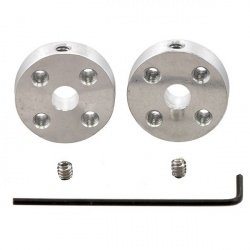
Aluminium Mounting Hub 5mm M3 - 2pcs. - Pololu 1998
Hub makes it easy to mount the wheel on the motor with the shaft of 5 mm using the M3 screws. The set has two pieces.
Index: PLL-01839
Index: PLL-01839
See also
What to look for?
Many beginners are tricked by the apparent ease with which mobile robot wheels can be supposedly connected to motors. In many designs, the wheels are driven directly by a motor shaft or gearbox. In smaller, lightweight amateur robots, a press-fit connection can be used - some wheels have been adapted to this method of mounting, and the only thing to look for is to match the diameter of the wheel mounting hole to the dimensions of the motor axis. However, larger or more precise designs require other mounting methods that not only provide adequate rigidity (no excessive play) but also strength and stability. In such applications, aluminum motor adapters, commonly called mounting hubs, come to the rescue. Hubs take the form of rings that are fastened to the drive shaft by a clamping screw, and the driven element (e.g. a wheel) is connected to the adapter via four tapped holes.
Other adapter variants
In addition to clamping hubs (suitable for drive shafts with diameters from 3 mm to 8 mm), we also offer motor adapters in the form of hexagonal sleeves that are clamped by screws on both sides. Each adapter of this type is adjusted to strictly specified shaft diameters - the elements available in our store have on one side a hole of 12 mm diameter, and on the other side - 3 mm, 4 mm or 6 mm. Of course, in addition to attaching the drive wheels of mobile robots, this type of elements can also be used in other mechanisms - for example to connect the axes of stepper motors to the drive screws of CNC devices or self-constructed 3D printers. In this category you will also find a number of other types of adapters for motors, such as bearing pulleys (smooth or toothed), clamping hubs compatible with MakeBlock system or adapters that allow you to connect different types of motors to LEGO wheels.
Connecting encoders to robot mechanics
Special attention should be paid to how the motor shaft is connected to the encoder axis. Because encoders are precise and relatively delicate sensors, they should not be subjected to any vibration or stress that might occur if the sensor axis is not correlated accurately enough with the motor shaft axis. In such situations, flexible motor adapters, usually called encoder couplers, should be used. These types of components accurately transfer the rotation to the encoder shaft, reducing unwanted circular movement of the axis (so-called runout) and thus protecting the sensitive encoder interior.