Over 500,000 customers already trust us. With us you get:
same-day shipping for products marked “24h shipping”
our own service centre in Poland
30 days to return and free delivery in Poland from PLN 500
4.9/5 on TrustMate and 4.9/5 on Google (almost 4,000 reviews)
VAT invoice, leasing and instalments for businesses
For businesses
individual quote for larger quantities
VAT invoice
For schools and universities
orders based on requests for quotation
help with choosing kits for your lab
Send an inquiry - we reply quickly.

Piano Solder Kit - educational kit for learning soldering - ATmega328P - Soldered 333181
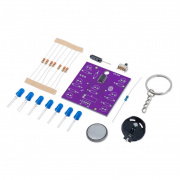
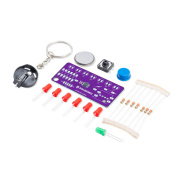
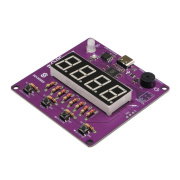
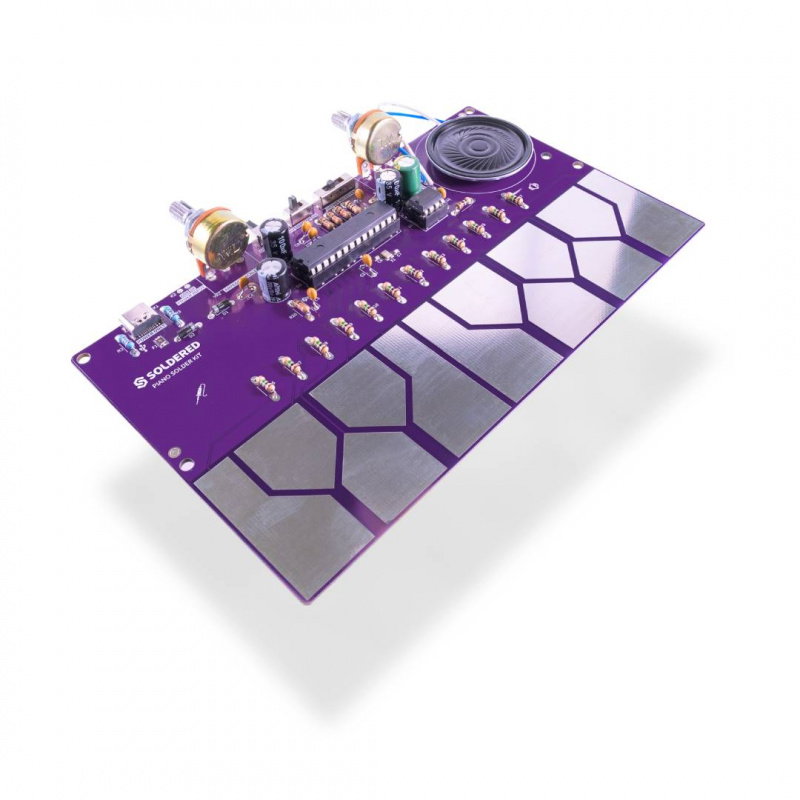
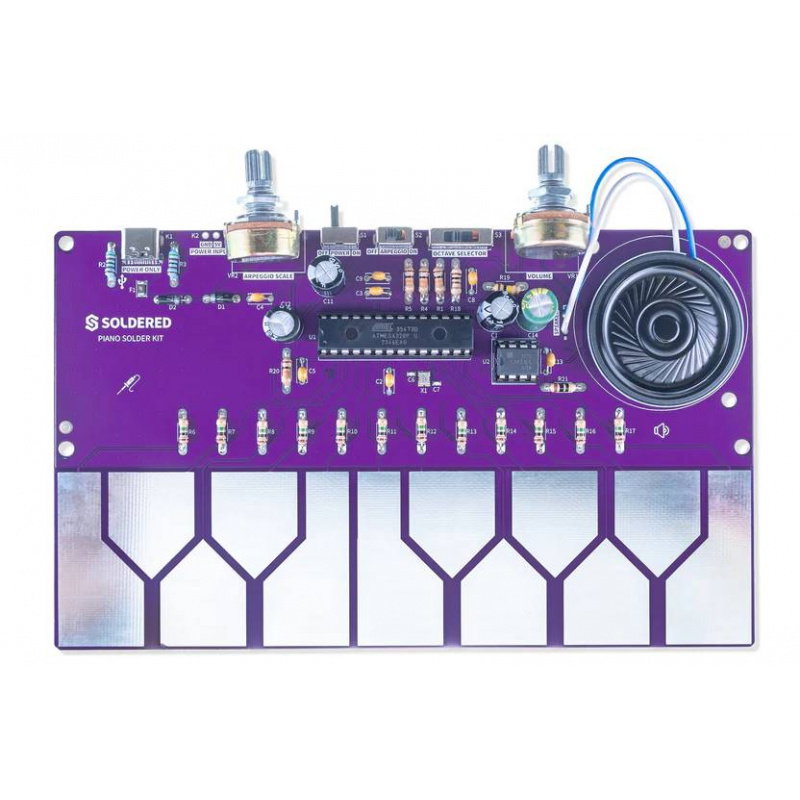
The Piano Solder Kit is an educational kit for DIY assembly of an electronic piano with 12 capacitive keys . This project allows you to learn the basics of soldering THT components, how microcontrollers work, and how capacitive touch technology works. Based on an ATmega328P microcontroller and an LM386 audio amplifier , the kit creates a fully functional musical instrument with volume control, arpeggio mode, and octave selection. Perfect for beginner electronics enthusiasts, students, makers, and STEM enthusiasts.
We could not load the price.
The promotional price does not combine with quantity discounts.
Product description: Piano Solder Kit - educational kit for learning soldering - ATmega328P - Soldered 333181
The Piano Solder Kit is an educational kit designed to teach soldering and the basics of electronics by building an interactive touch piano. The project utilizes an ATmega328P microcontroller, which is pre-programmed and ready to use after assembly. The instrument is equipped with 12 capacitive touch sensors , allowing for playing without mechanical buttons. The system utilizes an LM386 audio amplifier working with an included 8Ω speaker . Two potentiometers allow for volume and arpeggio speed adjustment, while switches allow for changing octaves and activating additional operating modes. Power is provided via a USB Type-C port . The kit allows you to acquire practical assembly skills while simultaneously building a functioning electronic device with a musical character.
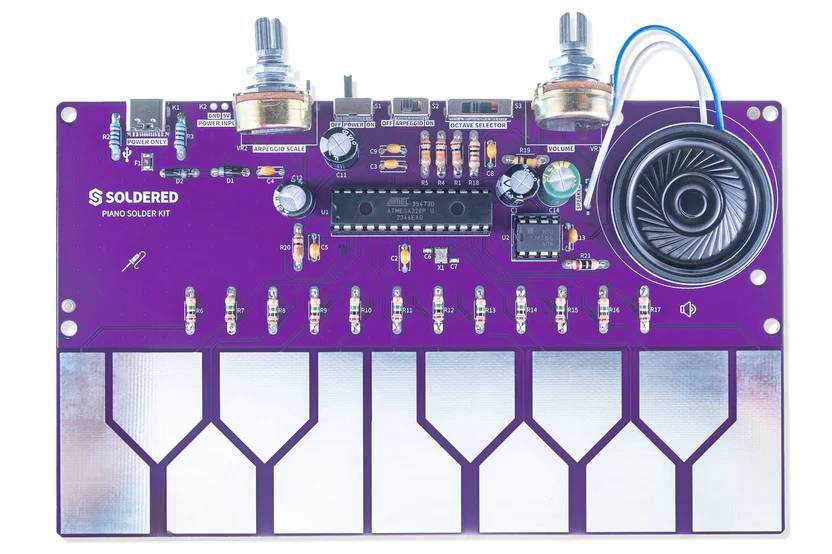
Piano Solder Kit - educational kit for learning soldering - ATmega328P - Soldered 333181.

Botland is an official distributor of Soldered products. Soldered is a European maker of modern electronic modules, sensors and accessories for DIY projects, education and industrial use. Soldered products stand out for build quality, inventiveness and easy integration with popular platforms such as Arduino and Raspberry Pi. Botland carries a wide choice of original Soldered modules for hobby and professional electronics projects alike.
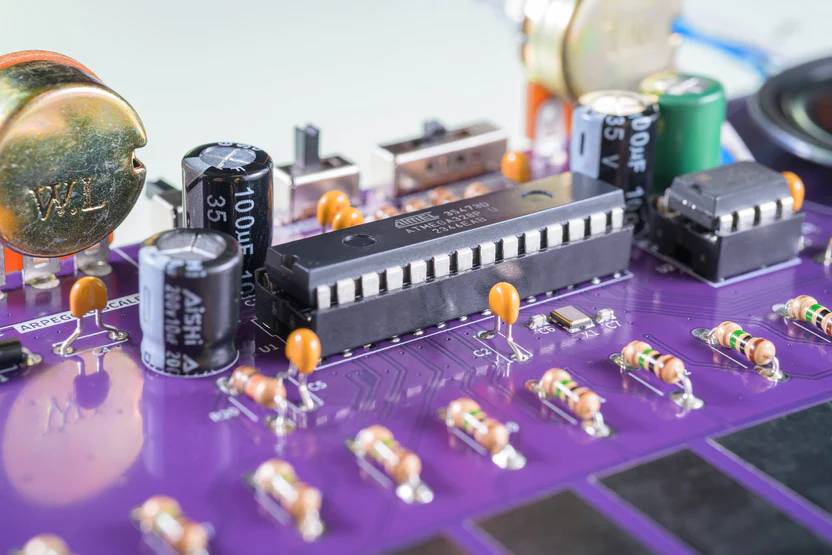
The Piano Solder Kit is an educational kit that allows you to build an interactive touch piano.
Key Features of the Piano Solder Kit
- 12 capacitive keys : touch control without mechanical buttons
- ATmega328P microcontroller : factory-programmed system ready to work after assembly
- LM386 audio amplifier : provides adequate amplification of the audio signal for the speaker
- Arpeggio mode : ability to automatically play a sequence of sounds
- Volume and arpeggio speed control : two potentiometers to control the instrument functions
- 4 octave ranges : expanded musical possibilities
- Learning THT soldering : practical exercise in assembling through-hole components
- USB Type-C connector : modern and convenient 5V power supply
- Open-source : access to source code and documentation on GitHub
- Included 8Ω speaker : allows you to immediately test the device's operation
Educational kit for learning soldering and electronics
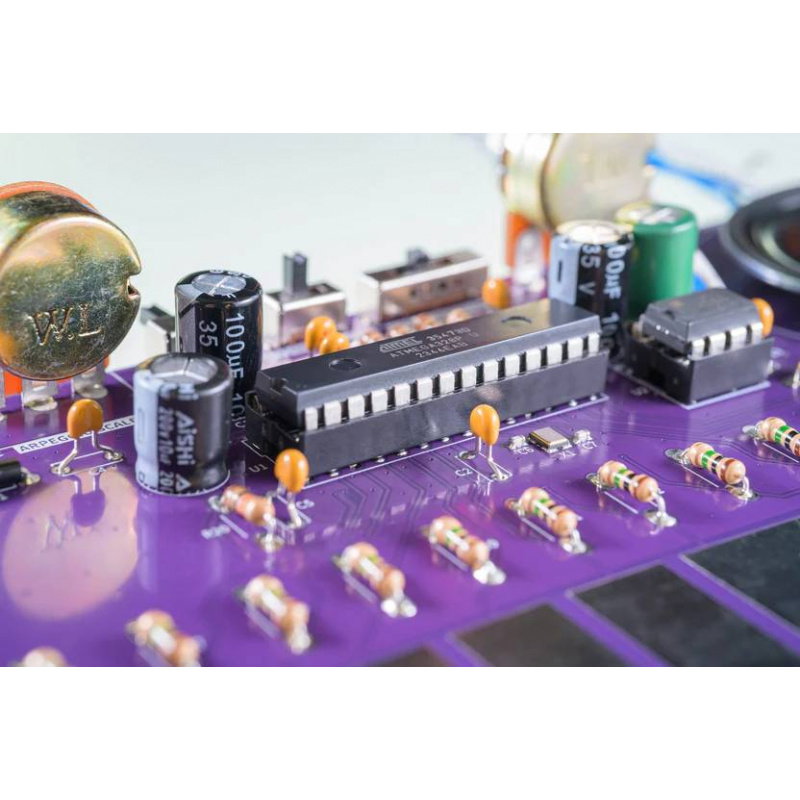
The Piano Solder Kit was designed as a practical educational tool for those just starting their adventure with electronics and soldering . You'll assemble all the through-hole components on a PCB yourself, so you'll learn basic soldering techniques, identifying electronic components, and the principles of proper electronic circuit assembly. As you assemble the kit, you'll learn to identify resistors , capacitors , diodes , and potentiometers. and integrated circuits . The project also demonstrates the operation of capacitive touch sensing technology, audio amplifiers, and microcontrollers used in embedded systems. After assembly, you'll have a fully functioning electronic piano that responds to finger touch . The kit requires soldering the components yourself and basic caution when using a soldering iron. Thanks to the clear, step-by-step instructions, it's suitable for beginners, students, hobbyists, makers, STEM labs, and school electronics labs.
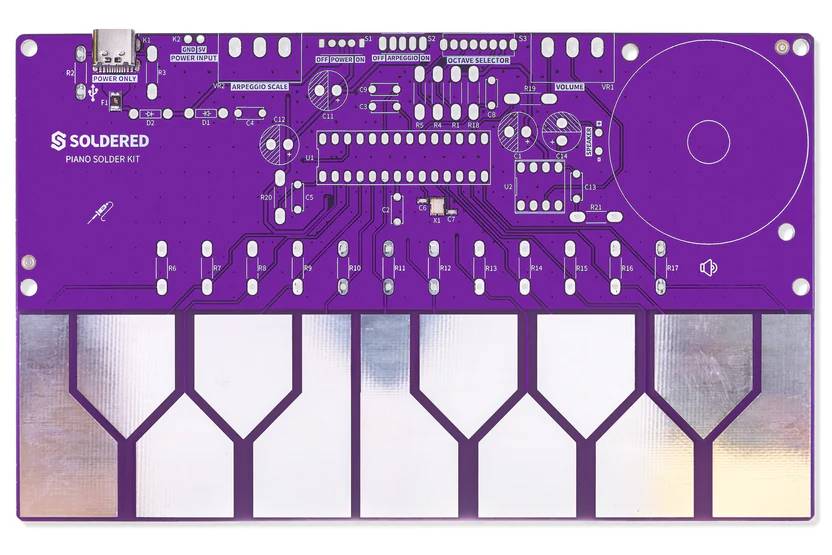
The project allows you to gain practical experience in the assembly of electronic systems and the diagnosis of correct connections.
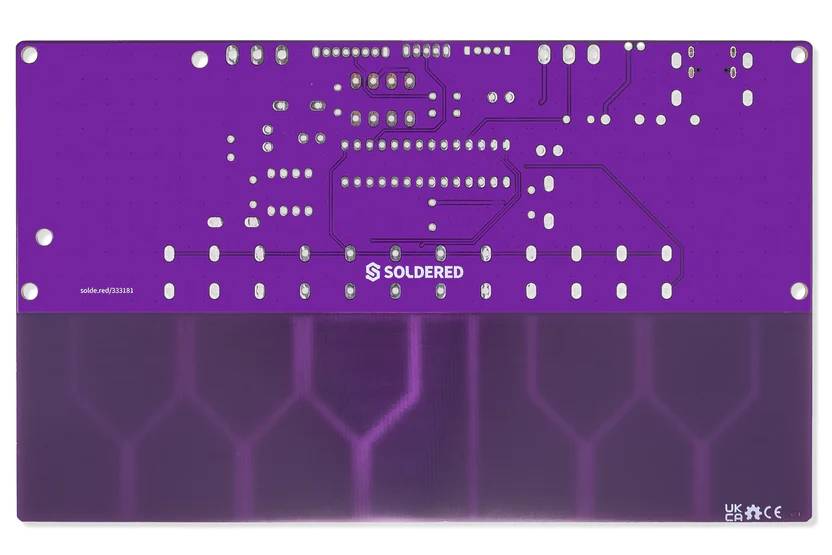
The Piano Solder Kit is perfect as an educational kit for learning electronics and soldering at home or at school.
Technical specifications of the set
- Microcontroller: ATmega328P
- Audio amplifier: LM386
- Number of keys: 12
- Key type: capacitive touch sensors
- Octave range: 4 octaves
- Volume control: 10 kΩ potentiometer
- Arpeggio speed control: 100 kΩ potentiometer
- Operating modes: arpeggio ON/OFF, octave selection
- Speaker: 8Ω
- Power supply: 5V via USB Type-C
- Mounting type: THT - through-hole
- Project type: DIY soldering kit
- Active elements: resistors, capacitors, diodes, integrated circuits
- Documentation and source code: open-source
- Dimensions: 165 x 98 mm
Contents of the set
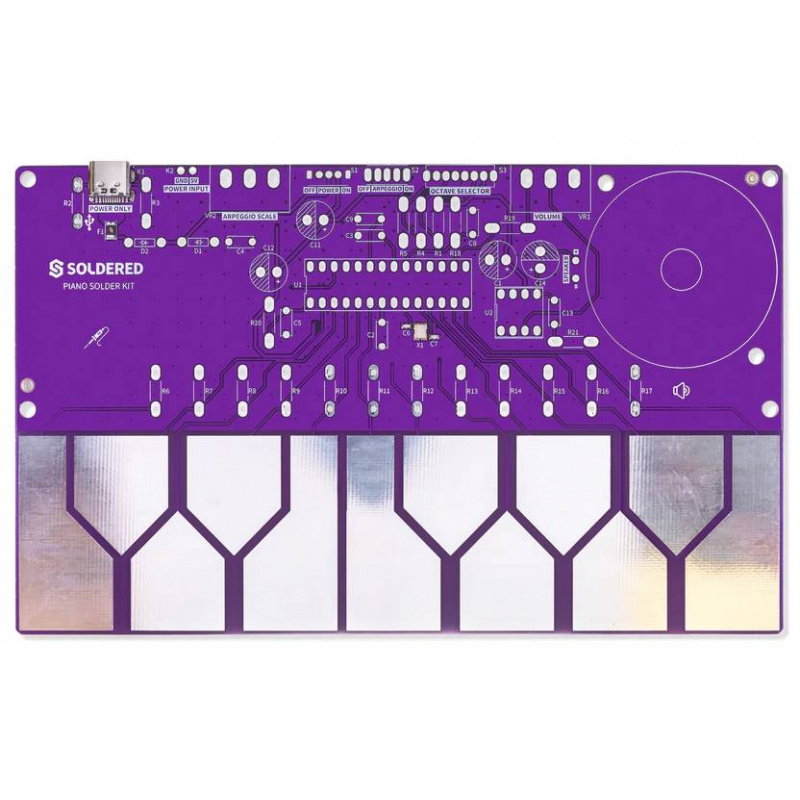
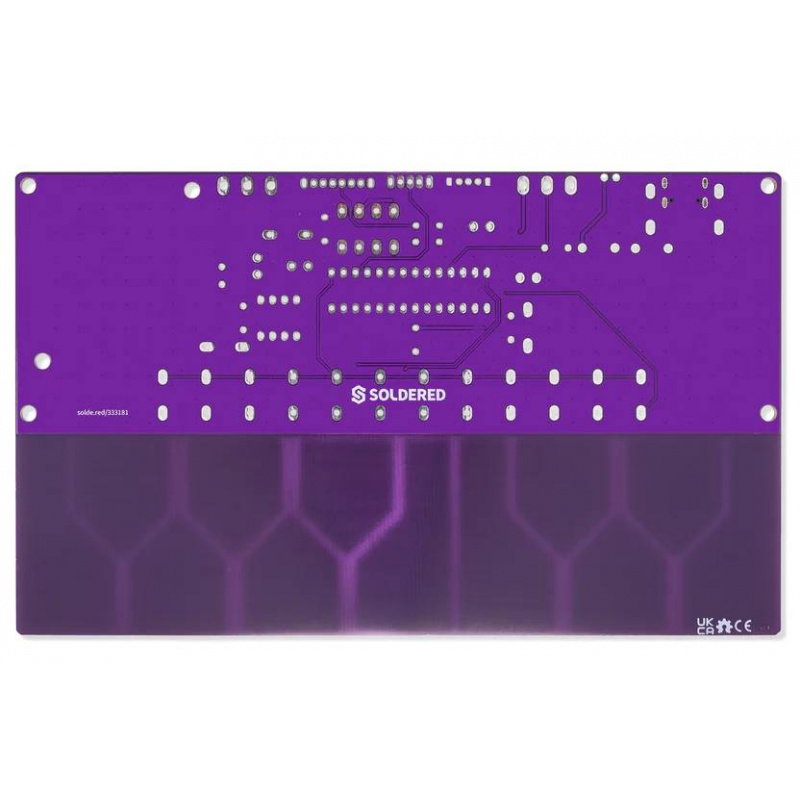
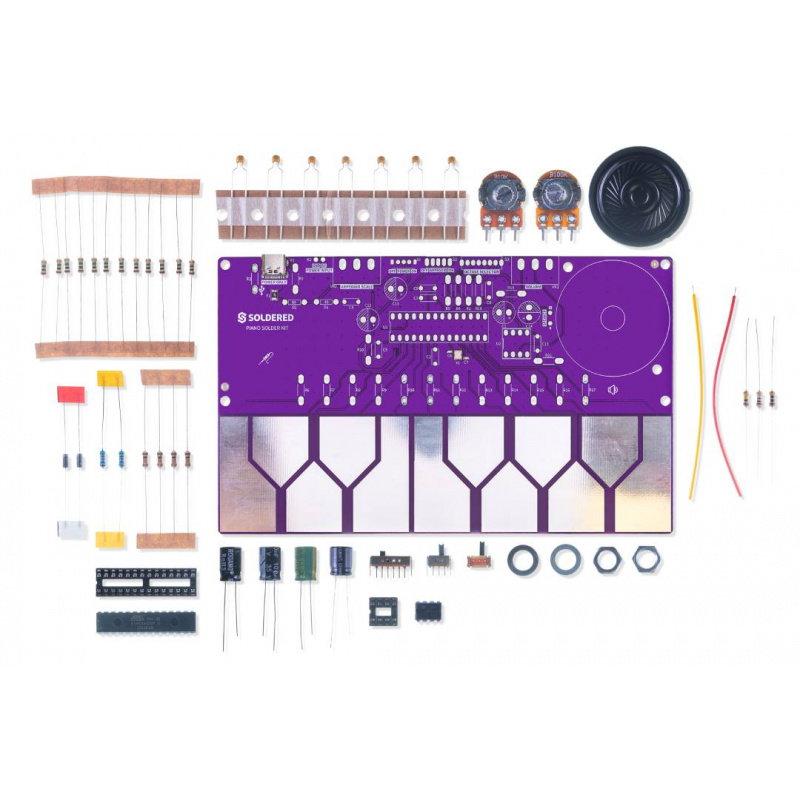
- Piano PCB with mounting markings, 12 touchpads, soldered USB Type-C connector, and 16 MHz quartz resonator
- ATmega328P microcontroller in a DIP-28 package
- DIP-28 socket for microcontroller
- LM386 audio amplifier circuit in a DIP-8 package
- DIP-8 socket for LM386 chip
- Arpeggio mode switch
- Octave selector switch
- ON/OFF switch
- 10 kΩ potentiometer for volume control
- 100 kΩ potentiometer for arpeggio speed adjustment
- 12 1 MΩ resistors
- 1 resistor 100 kΩ
- 5 10 kΩ resistors
- 2 x 5.1 kΩ resistors
- 1 resistor 100 Ω
- 1 resistor 10 Ω
- 7 ceramic capacitors 100 nF
- 2 electrolytic capacitors 100 µF
- 1 electrolytic capacitor 1000 µF
- 1 electrolytic capacitor 680 µF
- 2 diodes 1N4007
- 8 Ohm speaker
- 2 prepared wires for soldering the speaker
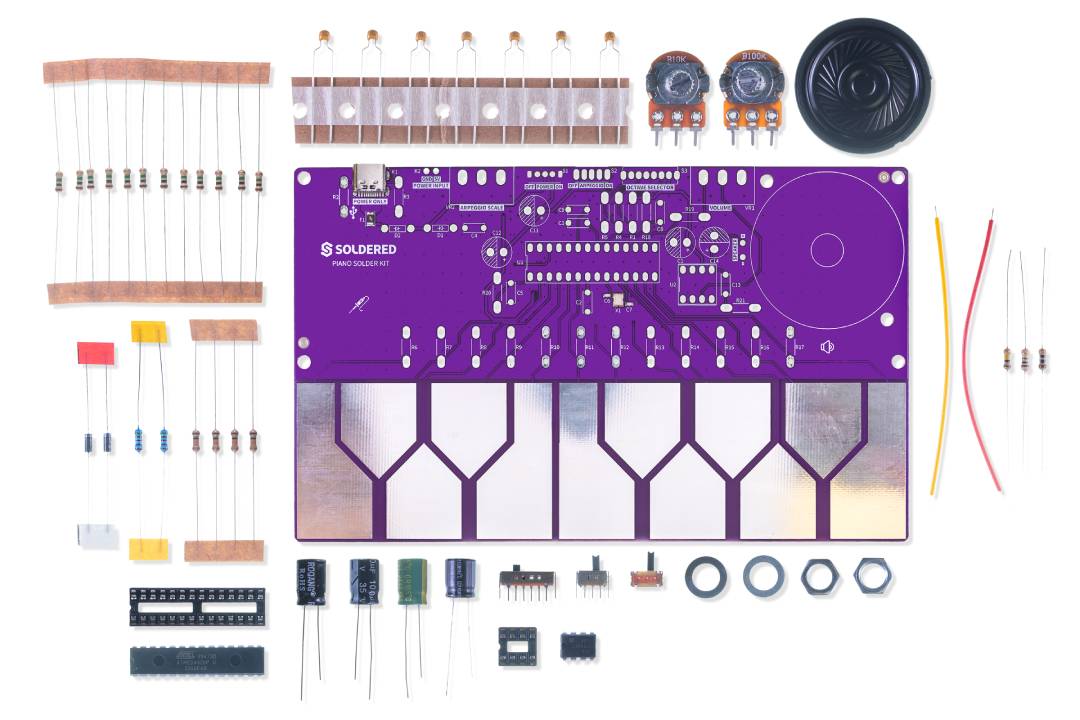
Elements included in the set.
Useful links
| Name | Value |
|---|---|
| Width | 16 cm |
| Height | 10 cm |
| Depth | 2.5 cm |
| Weight | 0.1 kg |
 GLS EU
Shipping in 24 hours
from €8.07
GLS EU
Shipping in 24 hours
from €8.07
 Raben
Delivery in 3–5 days, no inside delivery
from €96.75
Raben
Delivery in 3–5 days, no inside delivery
from €96.75
The full delivery terms are on the page Delivery and payment.
30 days to return, without giving a reason
If the product does not meet your expectations, you have 30 days from receiving the parcel to withdraw from the contract. The product only has to be complete. The right of return belongs to consumers (a purchase unrelated to business activity).
Complaints
If the product turns out to be faulty, you can make a claim under the guarantee or the statutory warranty. We handle claims without delay, at the latest within 14 working days of receiving the report together with the goods.
Be the first to ask a question about this product!
Instructions and documents
GPSR data
Product information
This product is a component intended for further assembly or prototyping. It is not a finished product within the meaning of the product safety regulations.