




On Sale

Potentiometers
Potentiometers are basic devices used to regulate potentials. In practice, the above names are more complicated than the process itself. However, one thing is certain - if you run your own workshop, love programmable electronics, automation and are a DIY fan, then you should have a potentiometer in your toolbox!
A potentiometer is a type of resistor with a sliding or rotating center tapping that creates an adjustable voltage divider. If only two pins are used - one end and the center tap, which slide over the resistive surface in the component, it acts as a variable resistor. Potentiometers are commonly used to control electrical devices such as volume control in audio equipment, rotational speed in electrical equipment. If you turn up the volume on the audio speakers at your desk, in the stereo in the living room, or in the car, you just use the knobs.
Potentiometers operated by more complex mechanisms can be used as, for example, position transducers in a joystick. Potentiometers are rarely used for direct control of significant power (more than a watt) as the power dissipated in the potentiometer would be comparable to the power in the controlled load. See our offer of potentiometers below and choose the devices that will suit you best!
Subcategories


Products


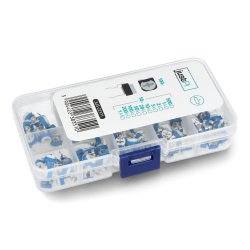


Potentiometers are adjustable resistors with a wide range of applications
Variable resistance resistors are often used to control electrical and electronic devices. These elements, depending on the geometry, allow converting rotational or sliding motion into a change in resistance ranging from zero to 100% of the nominal resistance of this element.
Additionally, if the potentiometer is used as a voltage divider using all three pins, then after connecting a constant voltage and ground to the extreme pins, a voltage proportional to the position of the potentiometer slider will be present on the middle one.
Construction and types of potentiometers
Potentiometers consist of a resistive element and a sliding contact that moves along the element. Additionally, this element has a mechanical system that moves the middle contact. Many potentiometers are constructed with a resistance element formed into an arc, usually slightly smaller than a full turn, and a contact that slides over the element as it rotates, creating an electrical contact. In panel potentiometers, the slider is usually the middle terminal of the three leads.
In the case of single-turn potentiometers, the contact can make one revolution around the axis (the axis diameter may vary, depending on the specific model) of the element (usually incomplete). In addition, the pinout raster may also vary. In the case of multi-turn potentiometers, mechanical elements are added that move the contact by, for example, a lead screw, or these elements have a spiral resistance element and a slider that rotates 10, 20 or more full turns.
A rotary potentiometer is often found in music players. Another type is the linear slider potentiometer, which has a slider that moves along a linear resistance element. Also known as a linear potentiometer. Slider potentiometers are used, among others, in the music industry to adjust volume and other sound parameters. There are also mounting potentiometers available in various variants of nominal resistance. In turn, a digital potentiometer is an integrated circuit that is adjusted digitally.
Rotary potentiometers - Basic parameters
The main parameter characterizing the potentiometer is the maximum nominal resistance. This is the resistance of the resistance band along which the slider moves and at the same time it is the maximum resistance value that can be set with the help of such an element. The second important parameter is the characteristics of resistance changes. In the passive elements category, in addition to potentiometers, there are also capacitors , resistors, resistors , magnets and many others.
Variable resistor (including for volume control) - additional information
The two main characteristics used in commercially available potentiometers are linear and logarithmic. Linear potentiometers have a linear relationship between resistance and slider displacement, and logarithmic potentiometers have logarithmic characteristics.
The last parameter of this element worth paying attention to is power. Although a potentiometer is rarely used in places where it would have to emit significant power, it is worth checking whether the selected element meets the requirements of a specific application in the device. Do you have additional questions about the product you are viewing or want to order your first breadboard but don't know which one to choose? Contact us via the contact form, by e-mail or by phone. Create a free account (it is not required to place an order). Registered customers receive, among others: information about current promotions.
Rotary, slider and linear potentiometers - FAQ
A rotary potentiometer is a device known colloquially as a radio knob. It uses a resistive element and a rotary contact to create an adjustable voltage divider. If only two terminals, one end of the element and an adjustable contact are used, it acts as a variable resistor . Slider and linear potentiometers work analogously to... sliders and in-line.
Since a potentiometer is like a resistor with variable resistance, its selection depends on many factors such as the supply voltage, the amount of current flowing or the voltage drop across it. It all depends on the project and what we want to achieve.
It's hard not to notice them. The outer pins are for power and ground, and the middle one is used as input. This means that the value coming from the third pin will change depending on how we turn the knob. Always pay attention to which wires are connected to which legs.