



On Sale

Gravity - converters
Products






See also
Signal isolators - safe transmission free from interference
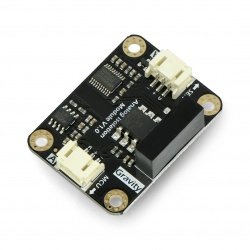
Due to its simple implementation, the I2C bus is one of the most popular solutions for communication methods in digital electronic devices. For data transmission, the I2C bus uses two lines, i.e. the clock line (SCL) and the data line (SDA). The speed of data transfer over the I2C interface, can be done in four speed modes, i.e. 0kb/s to 100kb/s or 400kb/s or 1.0Mb/s or 3.4Mb/s, with I2C most commonly used to transfer data at speeds up to 100kb/s and 400kb/s. Communication over the I2C bus is in both directions. In order to protect the data transmission from interference, it is advisable to add opto-isolation to the communication path. In contrast to I2C communication components, which operate in bidirectional mode (half-duplex), signal isolators implement unidirectional transmission. Nevertheless, such devices can be connected together very easily. The signal isolator module from DFRobot perfectly fulfils this task. Such an isolator splits the signals transmitted in both directions of the I2C bus into two separate unidirectional signals with negligibly small propagation time. Moreover, we have secured safe isolation from the mass of cooperating devices and protection against dangerous overvoltages.
I2C multiplexers - instant switching between I/O ports
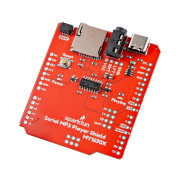
After finishing the project on Arduino, we can start assembling the hardware. Contrary to what you may think, the end result may turn out to be a bit problematic. When you connect at least two sensors that communicate over I2C to the Arduino pinouts, it may turn out that they have a permanently assigned I2C address. In that case, the sensors will not be able to work properly. The solution to this problem, is to use a digital multiplexer module. The Gravity series multiplexer module from DFRobot uses a specialized TCA9548A chip, which allows switching between eight signals transmitted over the I2C interface using a single main data bus. Simply connect sensors or other I2C bus compatible devices to the multiplexed clock and data line buses. If a signal conflict is detected on the multiplexer pinouts, simply apply a low state to the RST pin.
DAC converters - a successful transition from the digital to the analog world
In electronics we can distinguish devices by the type of time signals, i.e. analog and digital. In many cases it is necessary to change analog signal into digital form and also in the other way round. For example, if we want to listen to our favorite music that is stored on digital media, then we will need a digital-to-analog converter (DAC). The DAC module from DFRobot, based on the MCP4725 chip, provides 12-bit resolution of the output signal (approx. 1.2mV for 5.0V amplitude and approx. 0.8mV for 3.3V amplitude), making it ideal for music playback systems, test signal generators, and music synthesizer projects.