



New arrivals


On Sale

Gravity - buttons, keys and joysticks
Products






See also
Push buttons of tact switch type
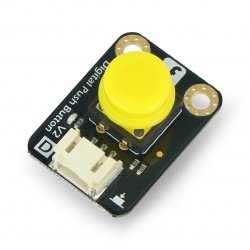
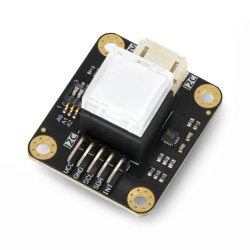
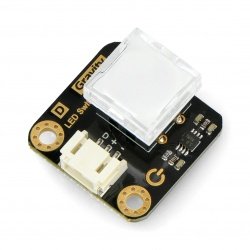
Pushbuttons of tact switch type are essentially monostable switches, i.e. their characteristic feature is one stable contact position (in majority of such pushbuttons, contacts in stable state are open). With tact switches, we can short-circuit two points in an electrical circuit that are not connected to each other without pressing the button - depending on the requirements and specifications of the application, either by pressing and releasing the button once, or by pressing, holding for a suitably long time (e.g. 5s), and releasing the button after achieving the intended change in the electrical circuit. For example, tact switch buttons are used in digital control of electronic devices, where by pressing the button, a short impulse in the form of high state (e.g. 5V voltage) or low state (short circuit to ground) is given to the input of a microcontroller. In response to a single press of the button, we can change the direction of rotation of the motor, turn on and off the LED lighting and much more. Offered by Botland monostable buttons from Gravity series are equipped with colorful keys - so you can build an attractive looking game console or multifunctional control panel for industrial robot.
Joysticks
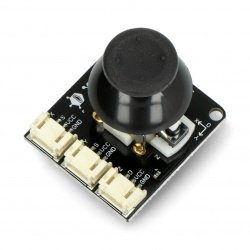
Joysticks are control elements that use both analog and digital technology. The movement of the joystick lever is possible in three dimensions, i.e. X, Y and Z. The movement of the joystick lever in X and Y axes provides a change of resistance of potentiometers on its outputs, whose leads are mechanically connected with the lever. In order for the microcontroller of the controlled device to read the joystick deflection data in both axes relative to the neutral position, it is necessary to use an analog-to-digital converter. The ADC reads the voltages from the X and Y leads of the potentiometers connected to the moving joystick. Moving the joystick lever at an angle between [0° and 90°] changes the voltage on both analog inputs of the ADC, but to read the signals concerning the position of the joystick in X and Y axes, connect one of the extreme pins of the potentiometers to the reference voltage source, relative to which the ADC measures. However, in case of joystick movement in Z-axis, it's enough to use digital pin of microcontroller which should be set as input by software. Joystick module from Gravity series has all necessary pins on connectors and allows to build many interesting projects like games console or operator panel to control robots and industrial machines.