



On Sale

Resistors
A resistor is a passive two-pin electrical element whose purpose is to create electrical resistance in a circuit. In electronic circuits, resistors are mainly used to reduce current flow, adjust signal levels, and split voltages. Resistors can also be responsible for the polarization of active elements and the termination of transmission lines.
Generally speaking, resistors are most often used to limit the flow of current. The role of the resistor is to take power and convert it into heat. The whole process uses Ohm's law. Some voltage is deposited on the resistor. The power itself is generated when electric current flows through the element and there is voltage at the terminals. There are many different types of resistors, but for standard products, the principle of operation is more or less the same.
Resistors are available with a wide range of resistance, spanning twelve orders of magnitude, and a wide range of wattages. Depending on the purpose, choose low-power resistors (0.125 W to 0.5 W) or high-power resistors for yourself and your project. There are also heating elements (1000W and more). In this Botland electronics store category you will find various products such as resistor kits, heating resistors, resistance wires and many other related devices! Check them all now. Buy in the Botland store and you will surely be satisfied!
Subcategories


Products


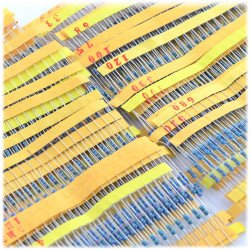


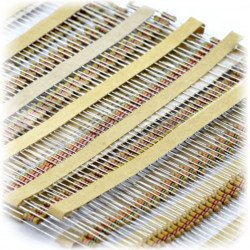


Resistors - basic elements of electronic systems
Resistors are the basic components of modern electronics and the most frequently used passive elements in electronic circuits. Resistors come in various forms and are composed of various chemical compounds. Resistors are available, among others, in the form of packages integrating several elements in one housing and implemented in integrated circuits.
Resistors - Different types of resistors
Resistors are manufactured from many resistance materials depending on the requirements of a specific application. They are most often made of materials such as carbon or metal deposited on a ceramic backing, but for higher power elements resistance wires are used. There are also specialized resistors, e.g. foil ones, characterized by high precision and stability of parameters over time and as a function of environmental conditions. The resistors are available in both through-hole (THT) and surface-mount (SMD) versions in a wide range of housing sizes.
Resistor - Basic parameters of resistors
The electrical function of a resistor is determined by its resistance: commercially available resistors are manufactured over nine orders of magnitude, and specialized components are manufactured over twelve. The resistance value relates the current flowing through the resistor to the voltage drop across that element. According to Ohm's law, the ratio of voltage drop to current is determined by the resistance of a given element. In addition to the resistance, each resistor has a nominal tolerance specifying the maximum deviation from the nominal resistance value of the actual element. The third very important parameter described by a physical resistor is the maximum power dissipated. It tells you how many watts of heat (a value that is the product of the current flowing through the resistor and the voltage drop across it) this element can dissipate. Exceeding this value may lead to failure.
Heating resistors
High-power resistors dissipating many watts of electrical energy as heat can be used not only as part of motor control in power distribution systems or as test loads. They are also often used as heating elements. This type of resistors are characterized by stable parameters that change slightly with temperature, time or operating voltage. These elements have a shape adapted to their task, which allows them to be easily installed in the device in a place that needs to be heated. They are equipped with dedicated mounting holes or self-adhesive tape that allows you to stick them on the device. They are used to heat delicate elements that require a stable temperature, as well as, for example, to heat the work tables of 3D printers.
Resistors, resistors - FAQ
A resistor is an electrical element that limits or regulates the flow of electric current in an electrical circuit. Resistors can also be used to apply a specific voltage to active devices such as transistors .
Selecting a resistor for an LED requires knowing the appropriate parameters and entering the values. The resistance value should be determined so that the current intensity is optimal for the powered LED. Kirchhoff's second law and Ohm's law are used for this purpose. The full guide and methods can be found on the Botland Blog in the article on selecting a resistor for a diode .
Resistors are divided into SMD , i.e. resistors used for surface mounting, and THT (Through-Hole Technology assembly). Another popular electronic element is a variable resistor, i.e. a potentiometer , which allows you to change the resistance using a knob. You know it, for example, from the radio casing. You can find resistor kits in Botland.
Due to their structure, we distinguish between carbon or metal resistors, in which a layer of carbon or metal is applied to a ceramic tube, film resistors with a metal alloy foil on a body made of insulating material, and wirewound resistors with a wire wound on an insulator core.
The parameter of a resistor is resistance, i.e. resistance. It is expressed in Ohms (ohms). The symbol of the unit is the Greek letter omega - for many people the mysterious sign Ω. It can be found in other sciences, but in physics it is associated primarily with resistance in the SI system.
Power is the amount of energy that flows in a given time. This produces heat energy (thermal energy), the excess of which can destroy our equipment. The power resistor will handle a much higher load than a normal metal film resistor. They are available in various variants: SMD, screw, plug-in, THD, as housing and more.
It is a measure of the resistance to current flow in an electric circuit. All materials resist the flow of electricity to some extent. They belong to two categories - they are conductors, i.e. materials that provide low resistance and in which electrons can move easily (e.g. silver, copper, gold, aluminum) and insulators, i.e. materials that provide high resistance and limit the flow of electrons (e.g. rubber , paper, glass, wood, plastic).