



New arrivals





On Sale


EEPROM memory
The EEPROM memory is an integrated circuit, which is designed to store important data of microcontrollers. These types of memories are also referred to as non-volatile semiconductor memories. Typically EEPROM is used to store a very small amount of data. In contrast to the EPROM, the data written in this way can only be erased by electric current. At the same time, it is very important that the data remains saved even after a power failure. Additionally, the number of data writes and data deletion is limited. It means that such memory cannot be used all the time - saving new data, deleting old data. The data write / erase cycle is from 10,000 to 1,000,000 one-time attempts depending on the specific device. However, these limitations do not apply to data processing - the number of data readings from EEPROM memory is infinite. The process of writing or overwriting can be a single byte (not like flash memory where cleaning and overwriting must be done in bulk). Specialized EEPROM memory is an innovative solution that is gaining popularity in robotics, automation and programmable electronics. Read our offer carefully and choose the highest quality EEPROM memory modules.
Products


See also
EEPROM memories - Offer details
Non-volatile EEPROM is one type of ROM (readable memory). Such an integrated circuit is found, for example, in Arduino microcontrollers. Depending on the purpose, it holds up to several dozen kilobytes. In practice, solutions are also commonly used in which such memory must be much larger. For example, in laptops, this type of memory is intended to store files needed for the BIOS software.
Writing and reading in EEPROM and FLASH memories
Writing (overwriting) in EEPROM memory is possible with single bytes - in FLASH memory, deleting and writing must be performed collectively. Such an operation requires the use of special access procedures and, above all, buffers to store larger amounts of data, and thus - the use of the device's RAM. The EEPROM system does not require such operations, making it perfect for situations where single byte recording is valued . Unfortunately, the consequence of such possibilities is slower communication (writing and reading) than FLASH memory. The number of reads from the EEPROM memory is infinite, but remember that the number of changes (writing and reading) is limited. Depending on the model and manufacturer, it ranges from 10,000 to 1 million cycles, and when it is exceeded, the memory stops functioning.
What do we offer in this category of our Botland store?
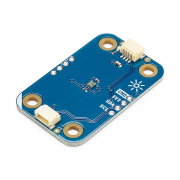
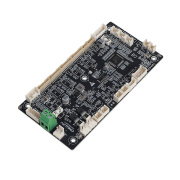
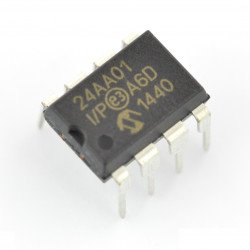
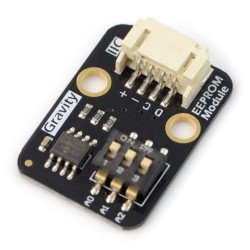
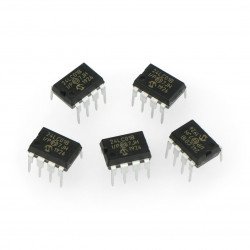
Our offer includes single soldering modules with a memory of 1 kB - it is divided into 128 8-bit blocks and communicates via the I2C bus. Individual models differ mainly in supply voltage (from 1.7 V to 5.5 V or from 2.5 V to 5.5 V). We also have a ready-made DFRobot PLC board, in which the manufacturer has provided four ready-made pins on a special connector (with a cable included). The device can be a 256 kB memory expansion for the Arduino microcontroller. Arduino's additional EEPROM memory board allows data to be retained during a power outage.
EEPROM memories - FAQ
FLASH EEPROM memory is used to build mass storage media such as FLASH USB , SD (Secure Digital) cards or MS (Memory Stick) cards.
EEPROM memory is non-volatile computer memory that can only be erased using electricity. It is most often used to record small amounts of data that must be readable after the power is cut off.