










- Reduced price
- Sale


- Sale
- Sale
Eco-Leather and Fabrics
Eco-leather and fabrics are materials used in decorative, functional, and technical projects. They are characterized by aesthetic finishes and easy processing. Unlike rigid materials such as Plexiglas or HDF, they are flexible and lightweight. They are recommended for projects requiring bending, sewing, and form-fitting, including those using Bambu Lab and Snapmaker machines. They are suitable for both handicrafts and work with machines, including lasers and plotters.
Products: 5
Loading...

A comprehensive set of materials for lasering and DIY. This package includes fine-grained cork, poplar and birch plywood, HDF board, and plexiglass. It's the foundation for...
Index: PKT-28433
Index: PKT-28433
- Kit
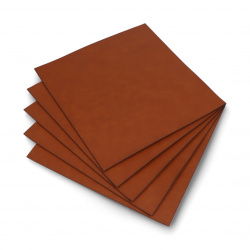
Engraving leather - cinnamon brown - 200x200mm - 5pcs.
Cinnamon Brown Engravable Leather is a synthetic material ideal for laser personalization. Its delicate texture mimics natural leather , making it an excellent choice for...
Index: MSL-27376
Index: MSL-27376
- Discontinued product
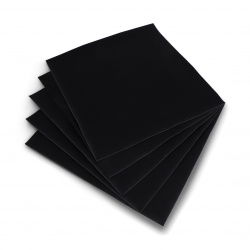
Engraving leather - black - 200x200mm - 5pcs.
Black engravable leather is a synthetic material ideal for personalizing with a laser plotter. Its delicate texture mimics natural leather , making it an excellent choice...
Index: MSL-27378
Index: MSL-27378
- Discontinued product
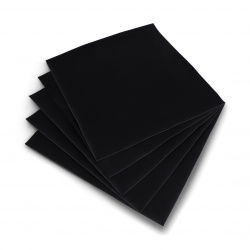
Engraving leather - black - 300x300mm - 5pcs.
Black engravable leather is a synthetic material ideal for personalizing with a laser plotter. Its delicate texture mimics natural leather , making it an excellent choice...
Index: MSL-27379
Index: MSL-27379
- Discontinued product

Engraving leather - cinnamon brown - 300x300mm - 5pcs.
Cinnamon Brown Engravable Leather is a synthetic material ideal for laser personalization. Its delicate texture mimics natural leather , making it an excellent choice for...
Index: MSL-27377
Index: MSL-27377
- Discontinued product
Eco-leather - facts and myths
Faux leather is not natural leather. It's a synthetic material, most often made of polyurethane (PU) or PVC on a carrier fabric. The name "eco" refers to the absence of animal skin rather than its full biodegradability, so it's worth remembering that the eco-character refers primarily to the absence of animal origin, not the complete environmental cycle. Faux leather typically consists of two main components: a base fabric, e.g., polyester, and a polymer coating, which is responsible for the appearance and properties of the surface. A popular myth, or rather an oversight, dictates that all faux leathers referred to as imitation leather are the same. In practice, there are many variants, differing in thickness, backing type, coating (PU or PVC), and surface finish.
How is eco-leather used in practice?
The combination of aesthetics and functionality dictates the requirements for textile materials in virtually every industry. This applies to the production of items such as cases, belts, patches, decorations, and finishing elements. Thanks to their structure, faux leather and similar fabrics lend themselves well to personalization through both cutting and marking. Laser cutting allows for precise shape cutting and surface engraving, creating a delicately etched effect. This solution is particularly popular in advertising and personalized projects, where repeatability and precision are key.
Eco-leather and fabrics for cutting
We've defined the category "fabrics" rather loosely because it combines soft and flexible materials, suitable for laser cutting, sewing, DIY, and personalization, and is often used in DIY maker, laser, and plotter projects. All of these are laser-cut and used in similar projects. Faux leather, as a synthetic material, is more uniform and resistant to stretching. It also produces a more technical finish, often used in utilitarian projects. Other fabrics, on the other hand, offer a wider variety of structures and thicknesses, from thin decorative materials to thicker, more durable variants. They are easier to sew and perform better in applications where the material needs to stretch, bend, or conform to shape. The choice usually depends on whether the project is intended to be more rigid and durable, or flexible and soft.
Laser processing of leather and cutting of soft materials - Bambu Lab and Snapmaker
Eco-leather works well with diode and CO₂ lasers. Precise cutting is achieved without the need for other mechanical tools. The laser reduces edge fraying, especially in synthetic materials, while also enabling the creation of complex patterns and details. Unlike Plexiglas and HDF, CNC machining is less common due to the material's flexibility. For this reason, the laser remains a fundamental tool, especially in projects requiring precision and repeatability. The most common solutions for these materials are diode and CO₂ lasers, which can be found in the laser plotters and cutters category. Optional CNC solutions include CNC milling machines and 3D/3-in-1 machines with the Snapmaker CNC module. Bambu Lab's particularly popular solutions are a true ecosystem of production and prototyping machines, including the Bambu Lab H2D Laser Full Combo 10W and the 40W variant from the same series. The latest direction of Bambu Lab H2D, Bambu Lab H2S and Bambu Lab H2C is characterized by dual nozzle solutions with laser and cutting developing multi-tool systems.