



On Sale
THT ceramic capacitors
THT ceramic capacitors - a capacitor is a passive electronic component. It is made of a conductor separated by a dielectric. A ceramic capacitor is much less sensitive to damage than an equally popular electrolytic capacitor. The store offers a wide range of ceramic capacitors - from the smallest capacitance (6,8 pF) to much larger (470 nF). All components are made using ceramics.
Products
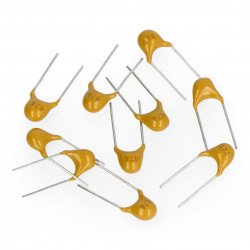
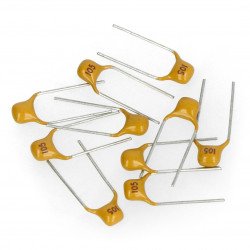
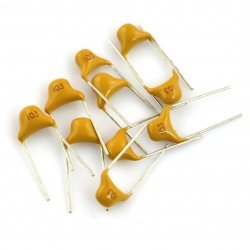
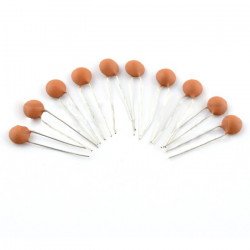

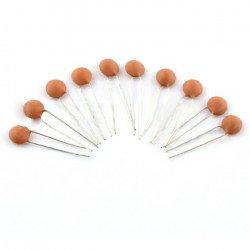
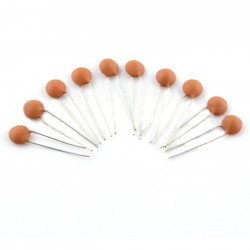
THT ceramic capacitors
A ceramic capacitor is made of one or more plates of ceramic materials. The ceramics used offer different properties, depending on the type of material selected. The relative permittivity is from several to several dozen thousand times greater than the permittivity of vacuum. Such high values allow you to build small components whose capabilities can equal those of electrolytic capacitors. A very big advantage of ceramic capacitors is the lack of polarization - this is their greatest advantage over electrolytic capacitors.
Principle of operation and application of ceramic capacitors
The operation of a capacitor can be compared to a buffer that stores energy inside and releases it for a while when it is cut off from the power source. The operation can be better illustrated by an example in which the LED is connected to a battery and the capacitor is mounted in parallel in front of the diode. When the circuit is closed, the diode will light up (and the capacitor will charge). After disconnecting, the diode will not turn off immediately, but only after a few seconds. The reason is to "release" the energy stored in the capacitor. Very often they are used together with coils to build filters to clean the signal or stabilize the voltage. Ceramic capacitors work great in systems where the voltage value can change very often. They are also perfect for use in digital electronics, which is based primarily on the use of microcontrollers. Ceramic capacitors are particularly good at filtering high frequencies. Unfortunately, they cope worse with low frequencies - electrolytic capacitors work exactly the opposite, so it is worth using them together, combining the advantages and eliminating the disadvantages. It is worth remembering that the price of ceramic capacitors is lower than electrolytic capacitors - this information may be important when purchasing larger quantities (e.g. for mass production).
THT ceramic capacitors - FAQ
A ceramic capacitor is a passive electronic element made of a conductor separated by a dielectric. These types of elements are used in almost every electronic device today. A good description of its operation is to compare it to an energy buffer which, after cutting off the power source, will continue to release the stored energy for a few moments.
Ceramic capacitors do not have polarization - only electrolytic capacitors have this. It is worth paying attention to this, because incorrect connection of the electrolytic capacitor will result in complete damage to the element and possibly even an explosion.
Electrolytic capacitors can lose their initial capacity very slowly. Most often, however, this is the result of, for example, leakage in the packaging or difficult conditions in which it worked.
The basic two types of capacitors are electrolytic capacitors and ceramic capacitors. There are also foil and tantalum capacitors. These types of elements can also be distinguished due to their adaptation to different types of assembly - for example, surface mounting (SMD) or through-hole mounting (THT) .