




On Sale

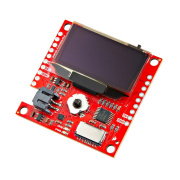
Converters step-up / step-down
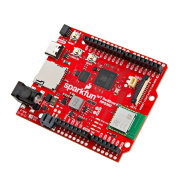
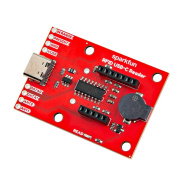
Step-up / step-down converters are advanced electronic devices that are successfully used in various production machines, motors and other applications. Step-up / step-down converters are tools that enable the conversion of DC voltage from the power source to DC voltage with a lower or higher value for the receiver. They can be used to increase and decrease tension levels. The construction of switched-mode power supplies is based on such converters. The working elements of step-up / step-down converters include semiconductor components switching capacitors, energy storage coils and anti-interference filters. Built-in output voltage adjustment potentiometers contribute to the fact that this type of converters are a very good solution as voltage regulators for receivers requiring non-standard supply voltage.
Products


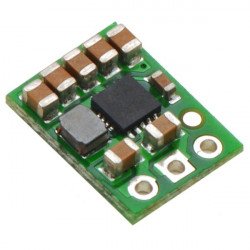
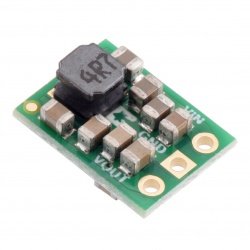


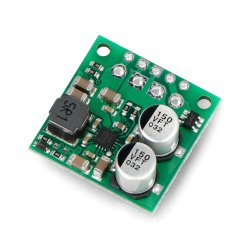
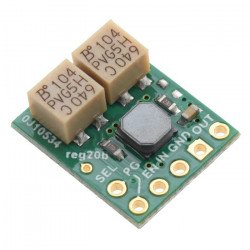

See also
What is a step-up/step-down converter and how does it work?
The step-up / step-down converter is a power electronic converter based on the buck-boost topology and converts the DC voltage from the power source into DC voltage for the receiver with a lower or higher value than the input voltage supplied by the source. The working elements of buck-boost converters include semiconductor switching elements in the form of a diode and a transistor key, capacitors and/or energy storage coils and anti-interference filters. When the switching transistor begins to conduct, a voltage is applied from the source to the coil, and the diode connected with the anode to the receiver receives a higher potential at the cathode, which is equivalent to its transition to the reverse state. When the switching transistor is turned off, the voltage across the coil drops and causes a change in the coil's magnetic flux, which causes current to flow to the receiver and a parallel voltage-holding capacitor connected to it. The transistor key is controlled by a square wave signal with variable duty cycle (PWM). The design and the mathematical apparatus describing it show that the output voltage in a converter in a buck-boost topology depends on the width of the control pulse in a proportional and disproportionate manner. This type of step up/step down converters will be useful in every workshop.
High-quality Polou impulse converters
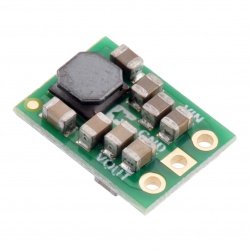
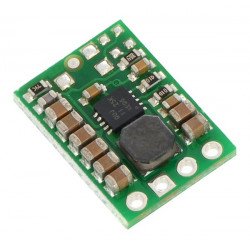
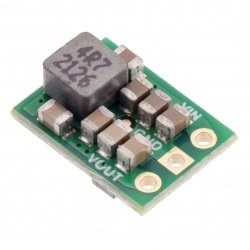
The S9V11X family of pulse converters from Polou is based on the Buck-Boost topology, which enables the conversion of the input voltage into a lower or higher voltage at the converter output. The supply voltage range includes values from 2.0V to 16.0V and they can be increased or decreased accordingly depending on the converter model. The efficiency of the converters is above 85% and the maximum output current is 1.5A. The flexible supply voltage range allows the S9V11X family of impulse converters to be used in battery-powered devices where the battery voltage is higher than that set at the converter output, and when it drops below this value, further operation of the powered device is possible. The S9V11X family of impulse converters are available in the Botland store in various output voltage variants, both in the version with a fixed output voltage and in the version with adjustable output voltage between 2.5V and 9.0V, adjustable using a 12-turn potentiometer. Built-in undervoltage protection prevents excessive battery discharge, and short-circuit and overload protection protects the system against damage.
Step-up / step-down converters - FAQ
You can build a voltage boosting converter yourself using one of many integrated impulse controllers available on the market. However, appropriate design and calculation of the converter is not an easy task, so it is worth choosing one of the ready-made power modules available in our store.
The principle of operation of a pulse voltage boosting converter is based on fast switching of a coil (choke), in which - as a result of changes in current intensity - a voltage is induced that "adds" to the system's supply voltage - appropriate selection of the control signal duty cycle allows obtaining the desired output voltage.
The classic, simplest step-down converter has a series choke connected between the output and the transistor switch, controlled by the PWM signal from the integrated controller. Between the key and the choke, the cathode of the Schottky diode is also turned on, the anode of which is connected to the ground of the system. Capacitors that smooth the voltage waveform are also an essential element of the converter.