



On Sale
Soldering irons
Soldering is a key-process that every DIY enthusiast should know. Everyone should also have a small soldering kit at home or in the workshop. In the Botland store, you can easily equip yourself with all the necessary tools!
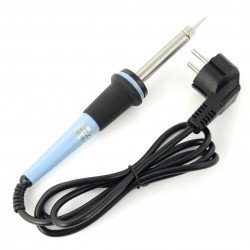
Soldering irons are one of the simplest and cheapest soldering tools. This is the type of soldering iron that is most often chosen by electronic beginners and students of technical universities. The device is very well suited for precise work on electronic systems (SMD or THT assembly). Thanks to the possibility of mounting various tips, depending on the needs, soldering irons can be adapted to different conditions. Nowadays, soldering irons are used almost exclusively to work with electronic circuits of small dimensions. The heating power of soldering irons varies, but the most popular models are low-power soldering irons, usually not exceeding several dozen watts (electric soldering irons).
Brazing is used for a variety of work where the goal is to connect two metal elements. It becomes possible due to the high temperature of the device and the solder. The melting point must be lower than that of the metals to be joined. The most common filler metal used during soldering is tin. It is in fact an alloy of tin (60%) with other fluxes such as silver or copper.
Check out the best soldering kits below and choose a tool that will help you in your work for many years!
Products
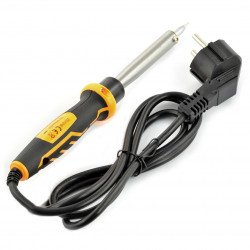
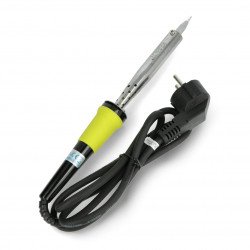
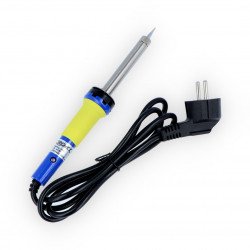
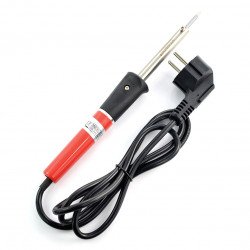
See also
Soldering irons
A soldering iron is a type of resistance soldering iron (heater) that heats a metal tip placed at the tip of the device with a heater. Depending on the need, the user can place tips of various shapes (usually a set of tips is included with the soldering iron - for example with a point or a flat tip). It is worth choosing the appropriate equipment depending on the task being performed: thin tips are suitable for heating small surfaces, while thicker ones - for larger ones. A soldering iron is significantly different from the transformer soldering iron often found as home DIY equipment. A resistance soldering iron will allow you to precisely solder small electronic components, for example those made using SMD technology.
A soldering iron is good for beginners and for professionals
A soldering iron is an excellent choice for a DIY enthusiast who is just taking his first steps as an electronics technician - equipment for a hobbyist for simple repairs. The investment in a soldering iron is small compared to the possibilities it offers. Very often it is the first choice for students of technical universities, equipment for a car workshop or supplementation of an electrician's equipment, taking up little space.
What we offer?
Our offer includes soldering irons with nominal power of 8 W, 23 W, 25 W, 30 W, 40 W, 48 W, 60 W, 100 W, 130 W, 250 W. These values determine how hard and how quickly Warm up the soldering iron. The supply voltage of the offered models ranges from 4.5 V to 240 V, while the temperature ranges to which soldering irons heat up are 160-480°C, 200-400°C, 200-450°C or 300°C. Most of the equipment comes from an OEM company, but we also have Elwik and Tex soldering irons. The lengths of such tools are 150 mm, 190 mm, 200 mm, 250 mm, 260 mm.
Soldering irons - FAQ
One of the simplest and cheapest soldering tools that many soldering beginners start with are soldering irons . They are characterized by handiness and an elongated shape of the stock. They are preferred when performing precise work on electronic systems (when assembling SMD or THT), you can change the tip in them.
An electronics soldering iron should be precise. It requires a thin, metal tip that can reach the smallest elements. It is worth choosing resistance soldering irons with temperature regulation or something else - soldering stations . For more information, see the article about soldering irons on the Botland Blog .
We advise against this practice for those unskilled in the craft and encourage you to choose tips from the Botland range. However, if you feel DIY, you can use a copper rod, usually with a diameter ranging from 1mm to 2mm. It should be clean and not covered with any material.