



New arrivals
On Sale
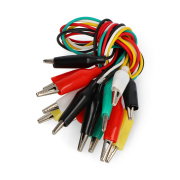
Single-strand wires
Wire jednożyłowe find very wide application in various electrical installations. Wires can be isolated or without isolation.
Subcategories


Products






See also
Single-core cables
Single-wire cables are tools popularly used in many everyday appliances - both domestic and industrial. Depending on their characteristics, these cables can be used for various tasks. They differ in such parameters as thicknesses of conductors and insulation, materials used and colours, which ultimately affect their suitability for specific electronic projects.
Operating temperature
Single-wire cables should have a specified range of temperatures in which they can operate efficiently and not be damaged. These are the operating temperature limits. For example, for an offered PVC wire cable with a length of 250 m and a diameter of 0.25 mm, the maximum ambient temperature value at which the cable will not be damaged and will conduct the signal without any obstacles is 180°C. Some products have specific limits depending on the voltage of the current that is to flow through the cable - we offer, for example, a Kynar assembly cable made of silver plated copper, which at 250 V is able to operate at temperatures from -65°C up to 200°C.
Deformation resistance
In many cases, the key parameter of the cable's suitability is its resistance to bending (if it is to be used in a device that requires frequent movement in the place where the cables are routed). A perfect example of application is the robot arm, on whose surface the power supply cables and gripper control signals are to run. An ordinary cable would have to be replaced very quickly, as it would quickly break inside the housing. The bending properties are determined by the production method and material of the cable. Our offer includes cables that are made of copper and braided from many thin wires, which gives them resistance to frequent bending over a small area.
Current parameters
The current limits are very important aspects of any cable to serve as an electricity carrier. They depend on the conductivity of the material from which the conductor is made, as well as on its cross-section and appropriately selected insulation. Most of the conductors in the cables we offer are made of copper (some have admixtures of perfectly conductive silver) - they differ mainly in the cross-sectional area. We have models with conductor cross-sections of 0.05, 0.5, 1, 1.4, 1.5, 2.5, 13.3 mm2. The insulation is usually made of polyvinyl chloride or it is a Teflon coating based on FEP (Fluorine Ethylene/Propylene/Propylene Copolymer). Nominal voltage values given by manufacturers depending on the model can be 300 V/500 V, 450 V/750 V or 250 V. When choosing, it is also necessary to pay attention to the current limit values - we have products that can conduct, for example, 4.3 A or 0.75 A.
Colors and length
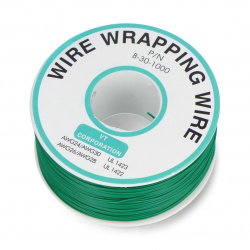
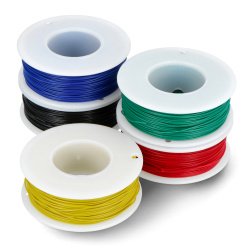
Depending on the application, the colours and length of the cable offered may be more or less key parameters. For example, for a project where a cable is to connect devices several dozen meters away, one long cable will do much better than several interconnected cables - the former always generates a loss of signal quality or a drop in energy on connections. We offer cables with lengths of 5, 10, 25, 50, 60, 100, 250 m, and even those that reach 305 m. In projects where a large number of connections are used, the colours of the insulation shield play a very important role. There are conventional rules among the electronics, which say what color should be the different types of connections - on this principle, red wires are usually "pros" and black are "cons" (GND). In our offer we have wires in red, black, white, blue, brown, green, yellow, orange, grey, and violet.