



Promotions
LED strips
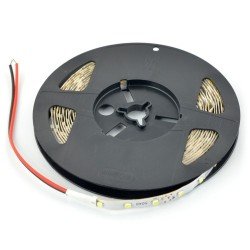
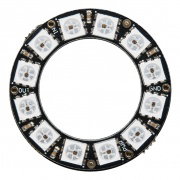
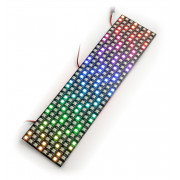
LED strips and strings are one of the most interesting solutions for energy-efficient lighting used today in households and apartments, public spaces, restaurants, shops and shopping centers. They can serve both practical as well as decorative functions, often combining them both, making them a common choice for modern interiors. LED strips can be of any length, we can easily adjust them to the specific area we want to illuminate. The diodes emit white light, but also colored light. We can equip the system with drivers and controllers, which will allow you to create lighting scenes and manage the light. A huge advantage of LED technology is its energy efficiency, which is one of those factors that have a key impact on the increasing choice of this solution. Moreover, the diodes emit very little heat, which makes them very well suited for close contact with heat-sensitive materials. LED strips and strings are available in different variants in Botland. Furthermore, we offer numerous accessories for light control and management.
Subcategories
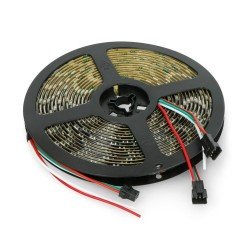
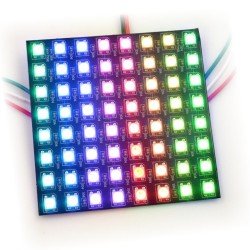
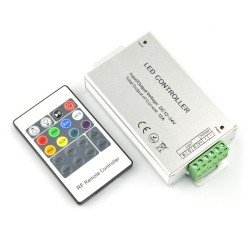
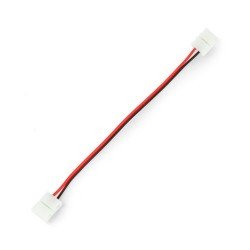
Products
See also
LED strips and chains - FAQ
The most frequently chosen option for LED interior decoration are standard LED strips, chains and tapes . Single-color LED strips do not require a controller, but to obtain interesting optical effects you will need an LED controller . They are characterized by low energy losses, high durability and luminance value, lighting efficiency and low power consumption.
LEDs technically cannot burn out because they do not have a jumper like traditional incandescent bulbs. "LED life limits" are a different matter - failures related to a fault in the electrical network, sparking, voltage surges or faulty fixtures.
Stick LED strips to aluminum profiles, metal elements, flat bars or other surfaces that can act as a radiator (heat dissipation) for the strip. Before gluing the surface, clean and degrease the surface.
Several LED strips can be connected together, with the maximum number of connections depending on the output power of the strip and the power source. You can connect LED light strips using connectors , cables or by soldering connections.
You can, but we don't recommend it. By cutting the LED strip in a place other than the designated cutting point, you risk damaging the elements on the strip itself. It is important to cut LED strips only on the specified cutting line between the indicating dots.
For the kitchen, we recommend standard LED strips of any length. It is worth choosing a warm, eye-straining color of the LEDs, with the option of dimming them. LED drivers such as BleBox ProxiDimmer also work great here.
The choice of LED for the bathroom is most often based on the brightness and color of the light. In general, LEDs marked as "daylight", whose color temperature is from 5000K to 6500K, or marked as "cool white" or "bright white", whose color temperature is from 3500K to 4100K, are suitable for bathrooms.
To some extent, yes, the LED strip does get hot. However, even if you use very strong diodes, the heating is much lower than with traditional light bulbs. LED does not burn, but the temperature of the outer housing of the LED is influenced by the temperature of the room and the fixture in which it is placed.
The most common causes of LED strip failure are power supply failure, installation errors, incorrect connection to the power supply, sticking the diodes on glass or plaster (don't do that), too long connections, low-quality LEDs, interference causing short high-voltage current pulses and moisture.
Make sure the total wattage of the LED strip is at least 20 percent less than the power supply's rated wattage. For example, if your LED strip requires 80 watts to operate, you will need a power supply with a power rating of at least 96 watts.
The discovery of asymmetric electrical conduction at the interface of a crystalline mineral and metal was made by Ferdinand Braun in 1874. The rectifier was renamed the diode in 1919 by the English physicist William Henry Eccles. We invite you to read the history of the LED on Botland Blog .
Tin the tip. Attempting to solder without a tinned tip is futile. Apply solder. Wipe off excess solder with a wet sponge, reapply a small amount of solder to the tip. The cleaner the surface, the better - remove dust, epoxies and other contaminants. If the high-power LED is to be placed on a heat sink (which is often the case), it is worth making the connections before mounting.
The easiest way to connect an LED strip is to use an appropriate mounting power supply , if necessary also using a matching driver .
The LED strip can be connected in the car using battery power supplies. You can also connect the tape directly to the vehicle's electrical installation, remembering to maintain the appropriate voltage and current parameters (if necessary, using appropriately selected resistors and other accessories ).
LED strips are usually self-adhesive. You can also use double-sided mounting tape or glue.