

















Most of today’s electronic devices is controlled by various types of processors and microcontrollers. Almost unlimited possibilities of programming different kinds of behavior, high computational performance and low cost of currently available chips made them ideal choose for designers. However, conventional microcontrollers also have an important drawback: all of programmed instructions are executed in turn, so in single-core processors (like over 99% of microcontrollers) there is no way to run two or more functions exactly at the same time. This enforces doing some compromises between execution time and complexity at given clock frequency. Multicore processors can handle some tasks at the same time, but even this solution may be insufficient in really high-speed, complex operations like multi-channel signal processsing, real-time video processing or some artificial intelligence applications. In these fields of technology another great family of devices can be used. It’s FPGA (Field programmable gate arrays).
- Reduced price
- Sale

- Sale
- Sale

FPGA boards and kits
Products: 14
Loading...
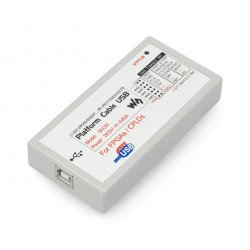
USB programmer and debugger for Xilinx devices - Waveshare 6530
A platform that allows you to program and debug Xilinx devices via USB. The device is based on CY7C68013A+FPGA chip, which is compatible with original Xilinx platforms. It...
Index: WSR-16398
Index: WSR-16398
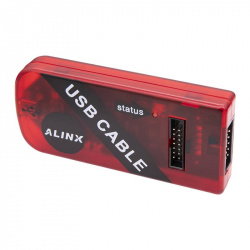
AL321 - USB JTAG programmer for Xilinx FPGA and CPLD devices
The ALINX AL321 is a USB JTAG programmer and debugger designed for Xilinx FPGAs, CPLDs, and configuration memories . It offers a 10-pin connector with a 2.54 mm pitch and a...
Index: ALX-29036
Index: ALX-29036
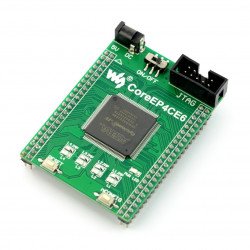
Altera Cyclone IV EP4CE6 - development board FPGA - Waveshare 6483
Development allow us to study the FPGA chips. The module is equipped with EP4CE6E22C8N with 80 I/O. The board is configured through the JTAG interface. It also has buttons,...
Index: WSR-13149
Index: WSR-13149
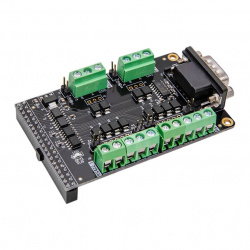
AN3485 - RS232/RS422/RS485 communication module for FPGA and SoC boards
The ALINX AN3485 is an industrial communication module designed to expand FPGA and SoC boards with serial interfaces. It offers one RS232 channel, two RS485 channels, and...
Index: ALX-29032
Index: ALX-29032
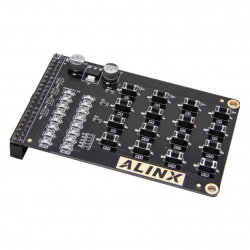
AN0404 - module with a 4×4 matrix keypad and 16 LEDs for FPGA and SoC boards
The ALINX AN0404 is an expansion module designed for FPGA and SoC development boards . It includes a 4x4 matrix keypad with 16 buttons and 16 independently controllable...
Index: ALX-29033
Index: ALX-29033
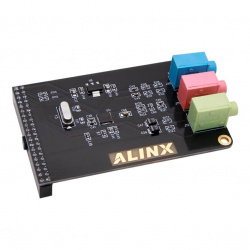
AN831 - audio module with WM8731 codec for FPGA and SoC boards
The ALINX AN831 is an audio module with the WM8731 codec , designed for use with FPGA and SoC development boards . It offers a microphone input, a line-level audio input,...
Index: ALX-29034
Index: ALX-29034
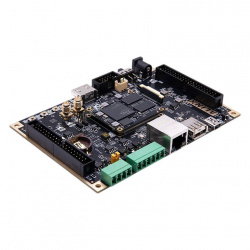
AX7Z010B - development board - AMD Zynq 7000 SoC XC7Z010
The AX7Z010B is a professional development platform based on the AMD Zynq 7000 SoC XC7Z010 , combining a dual-core ARM Cortex-A9 processor with programmable Artix-7 FPGA...
Index: ALX-29030
Index: ALX-29030
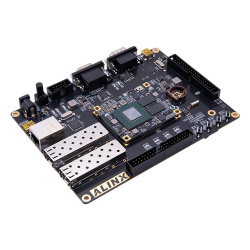
AX7202 - FPGA development board - AMD Artix 7 XC7A200T
The ALINX AX7202 is a powerful FPGA development board powered by the AMD Artix 7 XC7A200T , designed for communication, vision, and industrial projects. The kit offers 1 GB...
Index: ALX-29031
Index: ALX-29031
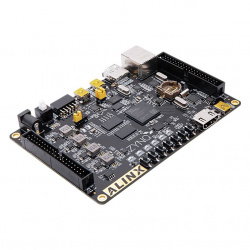
AX7010 - development board - AMD Zynq 7000 SoC XC7Z010
The ALINX AX7010 is a powerful development board based on the AMD Zynq 7000 SoC XC7Z010 , combining a dual-core ARM Cortex-A9 processor with programmable FPGA logic. The...
Index: ALX-29035
Index: ALX-29035
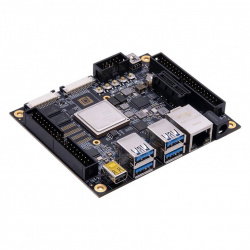
AXU2CGA - Development Board - AMD Zynq US+ MPSoC ZU2CG
The ALINX AXU2CGA is a compact development board powered by the AMD Zynq UltraScale+ MPSoC XCZU2CG , combining a dual-core ARM Cortex-A53 processor, two Cortex-R5F real-time...
Index: ALX-29040
Index: ALX-29040
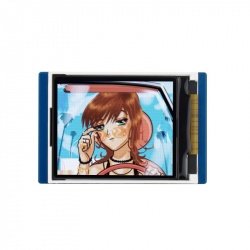
LCD TFT Display 1,8'' 160x128px - SPI - 65K RGB - for Raspberry Pi Pico - Waveshare 19579
A display designed for the Raspberry Pi Pico module. It has an ST7735S driver, uses a 4-wire SPI bus to communicate with the main module. The screen resolution is 160 x 128 px...
Index: WSR-19542
Index: WSR-19542
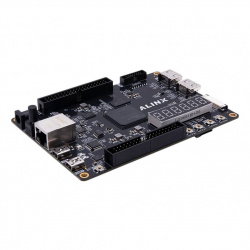
AX7035B - FPGA development board - AMD Artix 7 XC7A35T
The ALINX AX7035B is a powerful FPGA development board powered by the AMD Artix 7 XC7A35T , designed for learning, prototyping, and building advanced digital systems. It...
Index: ALX-29038
Index: ALX-29038
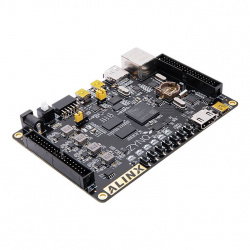
AX7020 - development board - AMD Zynq 7000 SoC XC7Z020
The ALINX AX7020 is a high-performance development board powered by the AMD Zynq 7000 SoC XC7Z020 , combining a dual-core ARM Cortex-A9 processor with programmable FPGA...
Index: ALX-29037
Index: ALX-29037
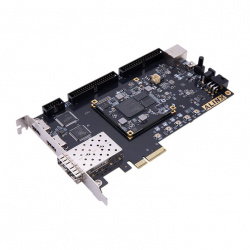
AX7A035B - FPGA development board - AMD Artix 7 XC7A35T
The ALINX AX7A035B is a high-performance FPGA development board based on the AMD Artix 7 XC7A35T , consisting of an AC7A035 System-on-Module (SOM) and a carrier board. It...
Index: ALX-29039
Index: ALX-29039
See also
FPGA – what is it and how can I use it?
FPGA is a special type of logic (digital) integrated circuit that can be programmed to do some tasks by user-reconfigurable hardware structure. Of course, large manufacturers of electronics can afford designing and ordering specific-function ICs (called ASICs), that ideally fits their needs. However this solution is very expensive due to overhead of IC structure manufacturing process. Therefore, in many applications the use of FPGA is the best possible solution. The FPGA chip contains hundreds or thousands of logical blocks that can be freely interconnected to perform parallel, application-specific tasks as it would be executed by custom ASIC. The process of generating instructions on how to connect the logic blocks is called configuration. Most of FPGAs are reconfigurable, so the “program” (configuration) is stored in external memory mount on the same PCB as the FPGA and loaded to FPGA internal configuration controller during system startup (it is, after turning on power supply). The configuration files are written using specific sets of “instructions” and commands, named hardware description language (HDL). Currently there are two languages used in daily FPGA development practice: Verilog and VHDL.
FPGA and CPLD development boards
In our store you can find great evaluation boards for both FPGA and CPLD chips. CPLD are another kind of programmable logic integrated circuits – they are less complex, slower and much cheaper than FPGA, therefore in some applications the use of CPLD is a quite sufficient solution. One of the most affordable FPGA development boards is Sipeed Tang Nano. The module contains GW1N-1-LV chip with embedded SRAM and user Flash memories, phase-locked loop (PLL), oscillator and of course FPGA array with 1152 LUT (look-up tables) and 864 flip-flops. The board uses USB C connector for power supply and built-in JTAG interface. The more complex, although still cost-effective Mimas V2 Spartan 6 FPGA Development Board contains Xilinx Spartan XC6SLX9 FPGA with 9152 logic cells, 1430 configurable slices, 11440 flip-flops and 90 kb of distributed RAM memory. The user can benefit from on-board 16 MB Flash memory with SPI interface, integrated USB 2.0 interface, 8 LEDs, 6 buttons, 8 DIP switches and a bunch of GPIO connectors for easy integration with external hardware. It also contains built-in 3-digit 7-segment Led display as well as power supply circuitry and JTAG connector. If you are interested in CPLD development, also check Waveshare DVK600 motherboard for CPLD/FPGA daughter boards.
High-end evaluation boards for advanced FPGA development
If you are already familiar with FPGA programming and searching for high quality, complex evaluation module for development of sophisticated applications, you can choose Numato Opsis FPGA board. It is intended to use in video processing applications and thus contains 256 MB of built-in RAM DDR memory running at 1600 MHz, 4 HDMI ports (two inputs and two outputs), as well as two Display Port sockets (input and output), Gigabit Ethernet and microSD slot. The system can handle up to 1080p / 30 fps video streams and supports display resolution of up to 4096 x 2304 px.