



New arrivals
On Sale
Tweezers
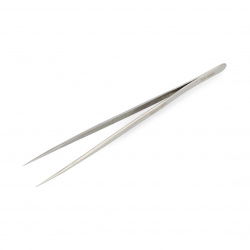
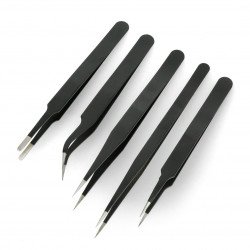
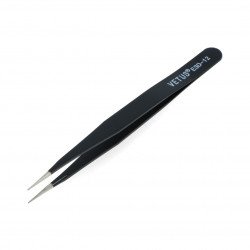
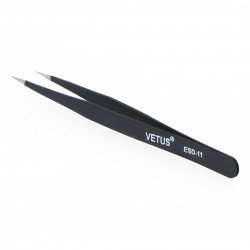
Tweezers are small tools that can be found in the suitcase of any electronics, robotics and DIY enthusiast. They are used for precision work, often in the case where it is necessary to place a small element in an equally small space. They are suitable for work requiring caution and avoiding direct contact of individual elements. In SMD we often deal with microscopic parts, without tweezers we are not able to perform proper soldering in such cases. However, tweezers have a much wider range of use, especially since they are available in many variants and types. You can choose between antimagnetic and antistatic tweezers, which will be an ideal choice for semiconductor systems where there are elements sensitive to static charges. We also offer SMD tweezers, straight and curved tip tweezers. All proposed products are made of high quality materials, have an ergonomic shape adapted to precision work and are of different sizes.
Products






See also
Types of tweezers used in electronics
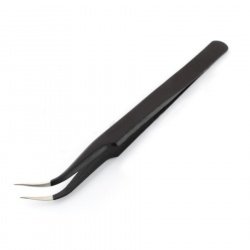
Tweezers can be divided both according to the materials used in their production and the specific functional properties resulting from this choice, as well as according to the shape of the tip of the tweezers and its length. While in the case of the last of these parameters there are no significant differences between tweezers used in electronics ( most models have a length from 10 cm to about 13-14 cm ), the shape of the tip has the greatest impact on the way of working and gripping possibilities. Straight and curved tweezers allow you to conveniently hold various elements, depending on their location and any additional equipment used at work. For example, if you solder using a microscope, curved tweezers may be a better choice, but in hard-to-reach places, you should consider using straight tweezers. Wide (smooth and serrated) tips are suitable for soldering integrated circuits in SO-8 and larger housings, while sharp tips are the only right choice for soldering SMD components with smaller dimensions (especially 0603 and smaller).
Special tweezers available at the Botland store
Particular attention should be paid to antimagnetic and antistatic tweezers . As is known, most semiconductor elements and systems are very sensitive to static charges. Discharges (ESD), associated with electrification of the operator's clothing, shoes and skin, can be fatal to - often expensive - components, hence the need to be particularly careful when manipulating them in the assembly or servicing process. In such cases, it is worth choosing anti-ESD tweezers, which will provide the elements with an appropriate level of safety. Antimagnetic tweezers are perfect for precise mechanical work and when manipulating certain electronic components, making it easier to work with, for example, small screws.
Measuring tweezers – no more problems with measuring SMD components
Anyone who has ever tried to measure the resistance or capacitance of an SMD element is perfectly aware of how difficult this task can be in the case of loose elements as well as those installed in the system (as long as it is known that the element can be measured correctly without desoldering). . Similar difficulties arise when measuring voltages on SMD components in working systems. These problems are eliminated by the UT-L01 measuring tweezers , equipped with cables with plugs compatible with multimeter sockets. Thanks to this practical tool, measurements of the smallest elements can be performed even with one hand, which makes work incredibly easier and faster, and specially designed measuring tips reduce the risk of damage to delicate components.
Tweezers - FAQ
For soldering small SMD components, tweezers with a sharp tip are best, as they make it easier to grip small electronic components. However, for other soldering work, you can use straight or curved tweezers with a flat gripper. You can also use antimagnetic and antistatic tweezers.