



On Sale

Soldering tips
Soldering is the most important step in the assembling of electronic devices. Of done February must have smoothness, Shine and durability, so how does this affect the correctness and reliability of the installed equipment. Outside the same skill with a soldering iron, important proper selection of the binder rations, but also auxiliary equipment and accessories. In order to obtain the best soldering results, the correct selection of the grotto soldering iron of suitable size and shape.
Products



See also
Selection of a soldering tip
The purpose of the soldering tip is to transfer heat from the soldering iron to the area to be soldered. In simple terms, it is best to choose a tip that will allow you to deliver high enough temperature in the shortest amount of time to complete the soldering in the shortest time possible without exposing the PCB and the components on it to damage due to too much heat over time.
Conical tips for soldering stations
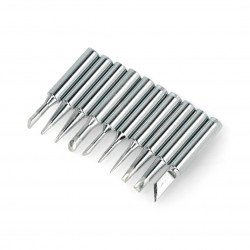
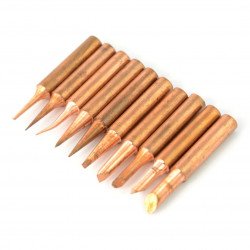
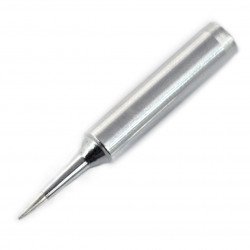
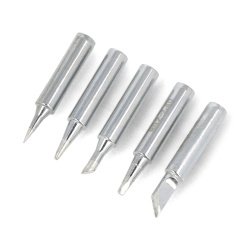
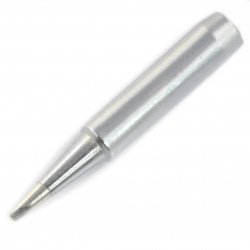
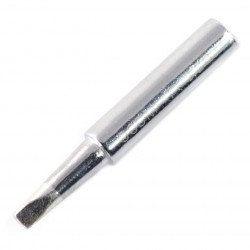
In real conditions, you can often deal with very small elements on PCBs, where the use of a large soldering tip is very troublesome - in this case, it is worth paying attention to its geometry. A tip cut on one side at an angle of 45 or 60 degrees significantly facilitates access to the tightest places in electrical circuits, but conical tips and rounded tips will also be helpful when soldering in small areas. The truncated cone shape of the tip is one of the most popular among professionals and DIY enthusiasts.
Soldering iron tips for more demanding tasks
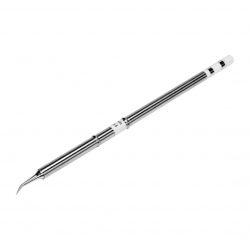
When soldering electromagnetic screens and disassembling electronic components, a sharp tip will be helpful, as its sharp edge allows access to areas where a large, traditional soldering tip cannot be used. When soldering surface-mounted components (SMD), it is best to use a mini-wave tip, the shape of which makes it easier to solder multiple pads (in the case of e.g. SMD integrated circuits) with a single pass of the solder, and also enables the removal of excess solder causing undesirable short circuits between the soldering points. If a large number of short circuits occurred during assembly, it is best to use a non-wettable needle tip with a reduced tendency to stick to the soldered surfaces.
How to care for soldering tips?
One of the factors affecting the life of the tip is the use of high-quality solder . Low-quality solder may contain impurities that, when deposited on the surface of the soldering tip, may worsen its thermal conductivity and make the soldering process more difficult. A good soldering filler should melt within a short time of applying a heated tip to it. For example, containing 60% tin and 40% lead (see also: Tins and solder pastes), it should melt easily at a temperature of 240°C. When metals come into contact with air, they may oxidize, and this also applies to soldering tips. To prevent this, use fluxes, wet sponges and brass cleaners to clean soldering residue. Our offer includes tips for heater soldering irons, transformer soldering irons and gas soldering irons. We also offer a set of arrowheads containing a different number and type of arrowheads.
Caverns - FAQ
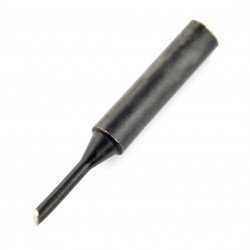
The tip is a special metal working tip that enables effective heat transfer to the soldered elements. In the case of soldering irons, it most often takes the form of an elongated cone with a mounting sleeve, and if we are dealing with a transformer soldering iron, the tip is made of an appropriately formed copper wire.
In the case of popular soldering irons, we have a wide selection of tips in various shapes and sizes. The general rule is that the tip size of the tip should correspond to the dimensions of the elements to be soldered - tips with a diameter of about 1.0..1.5 mm are usually suitable for assembling THT technology boards, while small SMD components require sharp cones of about 0. 5mm.