



On Sale
Arduino Shield - extension
The very first release of Arduino took place already in 2005. Basically, everything has changed since that moment! Over the past several years, Arduino has gained a lot of loyal fans. Electronics enthusiasts from around the world buy original printed circuit boards (PCBs), on the basis of which they build countless quantities of creative constructions. Many projects are used by the world of science, many of them are used to educate children in schools. Among the various designs, more advanced functional systems also deserve attention. Workshop improvements, home innovations, interactive toys, professional devices and laboratory systems – all of these can be now created with Arduino. In this category we present various Arduino Shields overlays that will be useful during building and programming!
Subcategories


Products




See also
What is Arduino Shield and what is it used for?
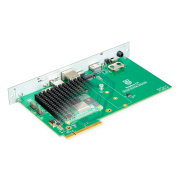
Arduino Shield boards are hardware shields, mechanically and electrically compatible with Arduino main modules (mainly Arduino Uno). This compatibility means, firstly, compatibility of the spacing and type of connectors (in this role there are immortal 2.54 mm goldpins), and secondly - appropriate voltage levels and pin layout, allowing for connecting Shield modules from various manufacturers (as well as self-developed ones) to Arduino DIY projects). Typical power supply voltage levels for the shields (as well as the main modules themselves) are 3.3 V and 5 V, although it is worth knowing that many Arduino Shield boards have separate connectors (usually screw) for connecting external power supply voltages. This is especially important in systems controlling high-power devices, e.g. motors or audio speakers. In such cases, the system gains two separate power supplies: the digital part (Arduino and the low-power circuits of the shield itself) and the high-power part (e.g. H bridges or the amplifier output stage).
Arduino Shield – interface and control systems
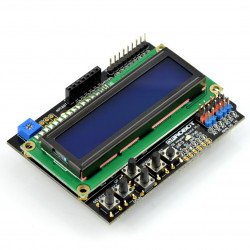
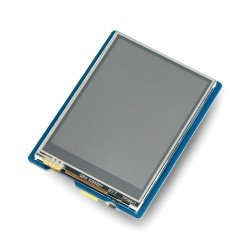
In this category you will find a wide range of overlays that extend the capabilities of Arduino boards with user communication functions. In addition to numerous modules with displays (LED, LCD, OLED) and keyboards, joysticks and touch panels, you can also order a number of boards that give Arduino the ability to connect to the outside world. And not only by wire (via Ethernet, RS485 differential bus or CAN), but also by radio. In the latter group, Arduino Shield shields deserve special attention, containing integrated GSM, Wi-Fi or Bluetooth communication modules and GPS receivers, although there are also simpler radio interfaces operating in the ISM band (e.g. Xbee).
Executive modules and more
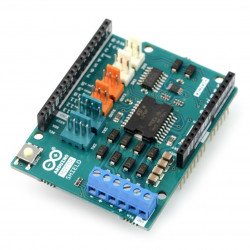
In the Arduino Shield category you will also find numerous shields that offer the ability to control external devices. From simple boards containing one, two or four electromagnetic relays, through LED and RGB strip controllers, to complex stepper and DC motor controllers and multi-channel modeling servo controllers. Anyone who plans to build a robot or other motorized machine will receive exactly what they need. The great advantage of such a wide offer is the fact that properly selected overlays free the designer-programmer from the need to create a new printed circuit board. They reduce the designer's involvement (related to the hardware side of the project) to the role of an integrator of ready-made solutions. This is not only a significant simplification, but also a significant saving of time and... money.
Arduino Shield - extensions - FAQ
Arduino Shield is a functional shield for Arduino series main boards , plugged directly into the goldpin sockets located in the microcontroller module. Depending on the model, Arduino Shield modules can extend Arduino functions with additional displays and keyboards, motor controllers, relays, sensors, communication modules and much more.