



New arrivals


On Sale



Laboratory power supply
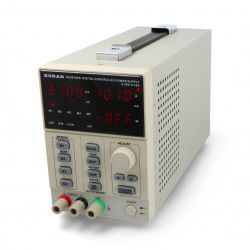
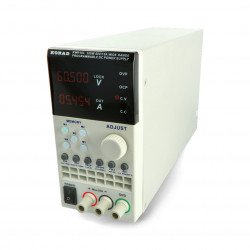
Bench power supplies are versatile components that can be used at various stages of electronic projects. We recommend them as a helpful tool during prototyping and calibration during the assembly of electronic devices. Moreover, they prove themselves in the repair of electronic devices and tests of already finished projects. Bench power supplies are distinguished by a unique, special design, which allows you to adjust the power supply parameters in a given moment, in real time. They are especially recommended for projects characterized by non-standard power supply voltage. Then, using a bench power supply unit, we will design a power supply section. Bench power supplies in our offer are available in many variants. We recommend them to people who deal with designing and creating electronic systems and all kinds of devices, as well as their repairs. They will also be a perfect complement to scientific aids in schools and universities, where there are scientific and didactic laboratories. They will definitely increase the possibilities of education.
Products




See also
What is a laboratory power supply and for what purposes is it needed?
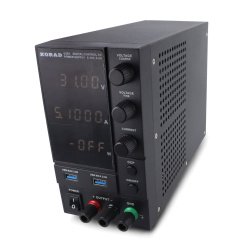
The laboratory power supply is a device constituting a source of electrical energy with the possibility of adjusting its output parameters , with the final output parameters being current and voltage with a constant time course. The ability to adjust these parameters makes the laboratory power supply a universal power source for many different devices, both at the design, assembly, testing and service stages, and for these purposes eliminates the need to have many single-voltage power supplies with different output parameters without the possibility of regulation. The regulated power supply can be easily set as a constant current source, e.g. to test the characteristics of semiconductor diodes, but also as a constant voltage source to check the efficiency of electronic components, e.g. relays or integrated circuits. Digital segment displays allow for easy and quick reading of the power supply's output parameters.
Criteria for selecting a good workshop power supply
Workshop power supply - Before purchasing, it is worth paying attention to the most important parameters of the regulated power supply so that it best meets the technical requirements while performing work. The first thing you should consider is the maximum output parameters of the power supply - current and voltage, so that you can run your projects without any problems. In addition, an important functional feature is the possibility of smooth, independent adjustment of the output parameters , i.e. voltage and current efficiency, and the ability to adjust these parameters in coarse and fine resolution. If you are a beginner in electronics, the built-in output current regulation will allow you to manually set a safe current limit to significantly reduce the risk of damaging components in your electronic system. In addition, built-in overvoltage, short circuit and overload protection also have a positive impact on safety during operation. In many cases, the use of a single-channel power supply will be sufficient, but for more complex projects that require several different supply voltage values, a multi-channel power supply (e.g. UNI-T UTP3305 available in our offer) will work very well, and when making production series of electronic devices of the same type with a repeatable startup and assembly pattern, the ability to save output parameters in programmable memory will be helpful. In terms of the method of transforming alternating voltage from the power grid into direct voltage, laboratory power supplies are designed as both impulse and linear. Switching power supplies are characterized by small dimensions and weight, but classic linear power supplies, equipped with a transformer and a linear voltage stabilizer, are perfect for powering analog circuits sensitive to voltage changes, because their design does not generate interference in the form of high-frequency signals to the network. A practical element of the power supply design are digital segment displays, which facilitate reading of the output parameters.
Laboratory power supplies - FAQ
Laboratory power supply not only for the laboratory! This equipment shows the current and voltage - you can always see what is happening. Current and voltage can also be set. In addition, the laboratory power supply has useful connectors, thanks to which you can easily connect a circuit or load to it.
Pay attention to the parameters of the laboratory power supply. The first issue is the maximum output parameters - current and voltage. Equally important is the option of smooth, independent regulation of parameters, i.e. voltage and current efficiency, and the ability to adjust these parameters in precise resolution. The segmented display makes it easier to read.