



New arrivals

On Sale

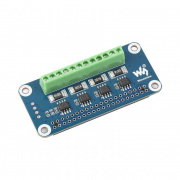
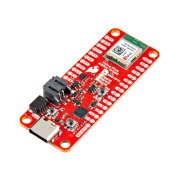

RFID modules & tags
Radio Frequency IDentification (RFID) is a modern transmission technology that allows you to identify almost any object completely wirelessly! All you need is radio waves.
Short-range radio communication (RFID) has entered so many areas of our lives that it would be really difficult to even briefly describe the most practical devices that use it. Basically, the radio waves sent by RFID transmitters are all around us! This technology owes its success to an extremely simple implementation. The need for separate power sources for all devices has been eliminated. This contributed to the growing interest in RFID transmission technology. While RFID modules require power, in the case of tags, the energy transmitted through the field generated by the transmitter's antenna is enough to activate it.
In this category of the Botland store you will find a number of ready-made solutions. We invite you to familiarize yourself with the sets of transmitting and receiving RFID modules, as well as RFID tags, available in various sizes and designs. Please notice that some products have implemented different functions such as an NFC reader, used for instant contactless payments.
Products








See also
Electricity without cables, i.e. power supply "from the air" - RFID CHIP
The most important, undeniable advantage of RFID technology is the ability to work without separate power sources for both communicating devices (i.e. RFID tags and readers) using radio waves. Although, of course, some devices (e.g. mobile) support RFID technology and have their own power supply, in the case of tags, the energy necessary to activate a small electronic system is transmitted by the same electromagnetic field that ensures proper data transmission between both devices. In other words, the RFID (radio-frequency identification) system, or more precisely, the magnetic field generated by the module's antenna (i.e. a special coil), induces a small current in the tag coil, which is enough to activate the system, decode the signal from the transmitter and send a short responses back to the sender (usually the message is an identifier, which - roughly speaking - is a unique string of characters assigned to a specific tag). RFID (radio frequency identification) systems are characterized by universal applications. They are mostly used as access control.
RFID CHIP - Standards, RFID standards…
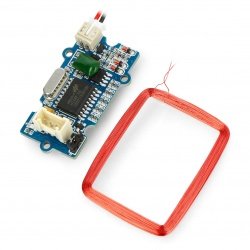
Many years ago, the world of RFID devices was divided into two main groups, differing in operating frequency and detection range. The first one operates at a radio signal frequency of 125 kHz, while the second one - intended mainly for proximity devices, i.e. with a range usually of several centimeters - operates in a band several dozen times higher (13.56 MHz). A different frequency forces not only differences in the design of RFID modules (RFID readers), but also in the size of the antenna itself - in the case of lower frequencies, slightly larger antennas are used, although the form itself (flat air coil) remains the same.
RFID technology - additional information
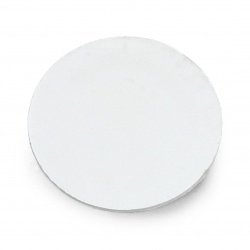
It is worth knowing that popular RFID tags come in various forms, depending on the target application. Self-adhesive "lozenges" are perfect for marking larger objects, while very small objects can be marked with capsule tags, resembling a slightly enlarged grain of rice with a diameter of about 2 mm and a length of just over 12 mm. Implementing RFID is not expensive, which is why this technology is so popular. Properly functioning RFID system
RFID modules and tags as well as an NFC reader in the Botland offer
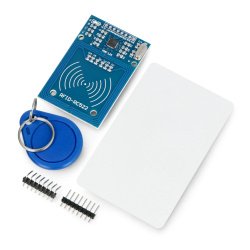
In this category, we have collected a number of practical RFID modules and tags that work in both standards described above. If you need a module to read 13.56 MHz tags, we especially recommend the Adafruit PN532 module with a built-in PCB antenna and the smaller SM130 Mifare module with UART and I2C interfaces, equipped with two rows of goldpins. The well-known and popular RC522 system, which is the heart of the inexpensive and very easy-to-implement ME138 module, will be perfect for basic applications. To support 125kHz tags, we recommend the miniature ID-12LA RFID modules from SparkFun and communication modules for the ID-2, ID-3, ID-12 and ID-20 series systems. Our offer includes, of course, a wide selection of RFID tags in the form of key rings, cards and capsules. RFID tags available in our store are characterized by increased resistance to mechanical damage. In practice, this means long service life and failure-free operation.
RFID modules and tags - FAQ
An RFID tag is a small electronic system composed of a transmitting and receiving antenna and a special integrated circuit. It does not require a battery or accumulator to power it - the energy source is the magnetic field generated by the RFID reader when approaching the tag.
RFID tags - also called RFID tags - contain a small integrated circuit embedded in a glass capsule together with the antenna, a plastic key ring, card, wristband or sticker. Tags with a frequency of 13.56 MHz are most often found in one of the last four versions, while capsules are also found in 125 kHz versions.
An RFID gateway is a device enabling the identification of persons and/or goods, as well as - in some versions - control of access to rooms or their zones. The main element of the gate is an RFID reader connected to the database - bringing the tag stored in it closer to the reader's antenna can, for example, unlock the electric lock , allowing a given person to enter the protected zone.
The integrated reader controller is connected to an antenna that generates an alternating magnetic field of a specific frequency. When the RFID tag is within the range of the field, a small voltage is induced in its own antenna , capable of powering the system, which enables transmission to be established with the reader controller.