



New arrivals


On Sale
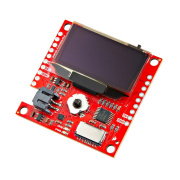
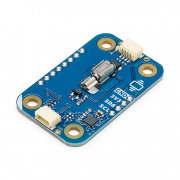
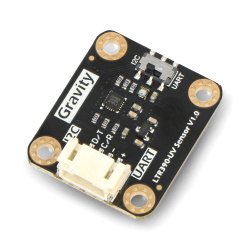
Gravity - light and colour sensors
Products





See also
Light sensors
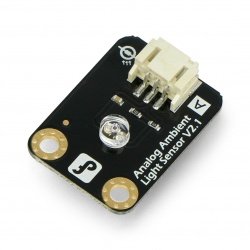
In light sensors, the first link in the measuring system is a photosensitive element, which is most often a photoresistor. It is a photosensitive resistor whose resistance changes depending on the intensity of light falling on its surface. When a photoresistor has a very high resistance at its terminals, it will be inaccessible to light. On the other hand, as a result of exposure to light, its resistance will decrease accordingly as the intensity of light falling on its surface increases. Photoresistive light intensity sensors may be used to build a twilight automatic device. In such a device, measurement of voltage drop on the photoresistor is performed in real time. After reaching a sufficiently low light intensity, in response to the measured value of the threshold voltage, the automatic device switches on the power supply of the external lighting (in order for the automatic device to work properly, the photoresistor sensor should be placed in a place which is optically inaccessible for the light from the lighting installation which is controlled by the device). Even more accurate measurement can be obtained using photodiode sensors. In photodiode, current flow occurs as a result of receiving light, which causes the release of electrons present in the structure of photodiode p-n junction. The current flowing through the photodiode is greater the higher the intensity of light reaching the photodiode.
Greyscale measurement with DFRobot sensors
In addition to standard solutions for light intensity and color scale measurement, we also offer custom solutions, such as gray scale sensors. The Gravity series grayscale sensor has been designed to perform light intensity measurements in the full range of colour grayscale. Such a sensor functions on the basis of the so-called optocoupler, which is a photoresistor combined with an LED diode. The grayscale measurement proportionally represents the light intensity emitted from the LED to the photoresistor. The Gravity series grayscale sensor is an analog sensor - the output signal from the sensor should be connected to one of the sockets in the "ANALOG" section of the Arduino base board. We also offer high quality licensed Arduino clones, such as the DFRduino from DFRobot. The most popular application where measurements are made with grayscale sensors is photography. When we take a picture with a digital camera, the reflected light from the environment is passed through RGB filters and it is converted into individual pixels of the photograph whose colors are determined according to the grayscale. You can also use the grayscale sensor to build a line follower robot.