





On Sale


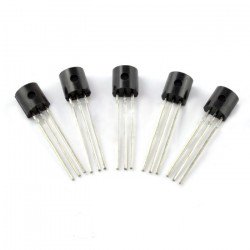
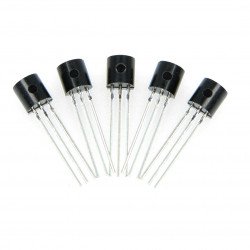
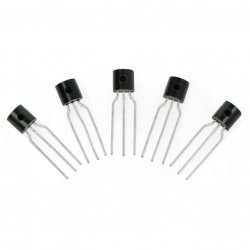
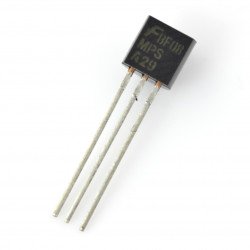
Transistors
Transistors have revolutionized the world. Today it is difficult to imagine advanced electronic devices without transistors. But what exactly are transistors and how do they work?
A transistor is a semiconductor device that is used to amplify or switch electronic signals and electricity. It is the basic building block of many modern electronic devices. You could say that transistors are all around us today - in the vast majority of electronic systems. Historically, the first device of this type practically put into operation was a blade transistor. The device was developed in 1947 by the American physicists John Bardeen, Walter Brattain and William Shockley. The transistor revolutionized electronics and paved the way for smaller and cheaper two-way radios, calculators and computers. The invention of transistors allowed the construction of many other new devices.
Nowadays, transistors are an essential element of any electronic project. For this reason, you will find tons of different types of transistors in the Botland Store. Choose from bipolar transistors and unipolar transistors. Choose also accessories, cables and cords, and other electronics.
Subcategories


Products



See also
Transistor – a universal electronic element
The transistor is a key element in virtually all modern electronic devices . The use of the transistor is extremely wide, which is why it is considered one of the greatest inventions of the 20th century . Its importance in today's society is based on its ability to be mass produced using a highly automated process that achieves astonishingly low costs. Even though the vast majority of transistors are now manufactured on integrated circuits, there are still many types of different discrete transistors available on the market.
Principle of operation of transistors
A transistor is a semiconductor device consisting of three layers of semiconductor that control the flow of current. Moreover, this element is equipped with at least three pins for connection to an external circuit. A voltage or current (even a small current) applied to one pair of transistor terminals controls the current through another pair of terminals. Because the controlled (output) power can be higher than the control (input) power, the transistor can amplify the signal. Most transistors are made of very pure silicon or germanium, but other semiconductor materials can also be used. To put it simply, a small current flows between the emitter and the base and can control a larger current that flows between the emitter and the collector.
Transistors - Available types - what's the difference?
What is worth knowing about bipolar transistors? A bipolar transistor (BJT) can contain only one type of charge carriers, in a field-effect transistor (FET) two types of charge carriers can coexist simultaneously. These elements differ in their structure and, consequently, in their operating principles. High power transistors are also used in electronics.
Bipolar transistors - what else is worth knowing about them?
Bipolar transistors are so called because they operate using both majority and minority carriers. Such a transistor is a combination of two diodes. The transistor is made of a thin layer of one type of semiconductor placed between two layers of the other type (PNP or NPN). In contrast, a field-effect transistor, sometimes called a unipolar transistor, uses electrons or holes for conduction. In addition to a wide selection of transistors, we also offer a practical electronics course , containing basic information about the most frequently used electronic components.
Transistors - FAQ
Simply put, transistors are devices that regulate the flow of current or voltage and act as a switch or gate for electronic signals. Transistors consist of three layers of semiconductor material, each of which can conduct electricity.
It depends on the project. A bipolar transistor can contain one type of charge carriers. Two types of charge carriers can coexist in a field-effect transistor (MOSFET). Bipolar transistors operate using both majority and minority carriers. A field-effect transistor, or unipolar , uses electrons or "holes" for conduction.
Transistors are the basic invention after semiconductors that have helped the world a lot. Parameters such as voltage, current or bandwidth can be changed by modifying passive elements . Simple projects with transistors include any systems with a flashing diode, clocks of your own design or an automatic night light. There are plenty of possibilities.