



New arrivals
On Sale
Linear motors
To select the right electric actuator for your gate, you can use the calculator:
ELECTRIC ACTUATORS CALCULATOR
Some electronic projects require special components. The solution to many problems will be to buy a professional linear actuator! You can buy it now in this Botland store category!
Electric linear actuators are devices that convert rotary motion from an electric motor to linear motion. Solutions of this type are used in many areas. Actuators are commonly used in car locks, electric locks, intelligent building systems, agricultural machinery, technologically advanced robots and industrial automation systems. By building a robotic project using the programmable electronics available in our store, you can also enrich your structure with new possibilities thanks to the use of actuators. Electric actuators are one of the most important elements in the construction of moving parts of a given structure. Thanks to this, we can build a linear motor with the appropriate range of motion! Check what we have prepared for you below!
Subcategories


Products
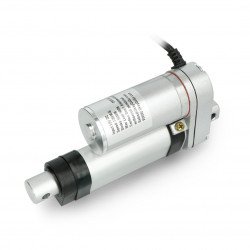
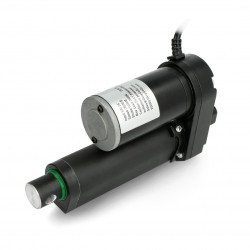
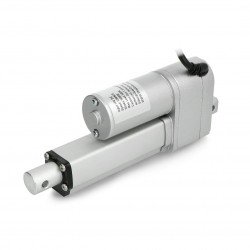
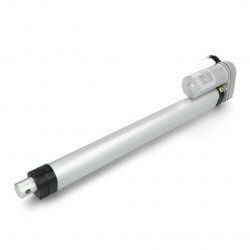
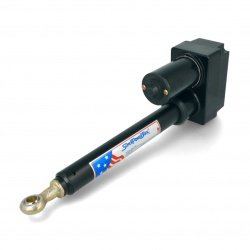

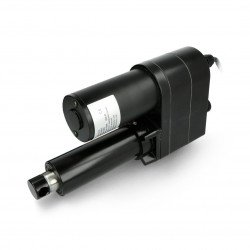


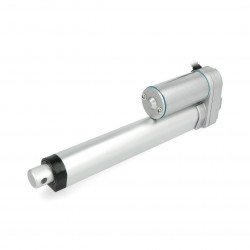
Linear Actuators - Build a linear motor
How does an electric actuator work? Electric linear actuators are devices that most often use small electric motors and then use their rotational motion (mechanical energy) to convert it into linear motion. This can be achieved, for example, by using appropriate threading inside the device. However, you should know that linear motors can also be used for this purpose. They use the properties of the electric current flowing through the coil and the ferromagnetic material placed inside.
Electric linear actuators - application
Depending on the direction of the electric current on the coil, the ferromagnetic inside moves in the appropriate direction. Such solutions are used primarily in railways. In addition, the fast electric actuator is used in household appliances and various precision mechanical systems. Their main advantages are positioning precision, speed and acceleration not limited by friction or inertia of elements.
Linear actuators have the advantage of self-braking when the electric motor is not running. This means that if the motor is not running, the piston cannot be extended or retracted - the actuator will hold the weight even when the power is turned off.
Application of electric linear actuators
Electric linear actuators are used in car locks, electric door locks in smart buildings (automatic door openers), as well as for various applications in industrial and home automation (e.g. for mobile solar collectors).
They are also used in agricultural machines. Often, such a device is controlled via radio, using special modules that support wireless communication.
They are also used using manual or automatic control - for example, in response to a signal from appropriate sensors informing about the detection of a given change. In addition, a professional electric actuator is used, among others, in industrial machines (
Electric actuators - What do we offer?
We offer a wide selection of approximately 40 models of electric linear motors . Most of them are powered by 12V DC , but 24V and 36V models are also available. For the device to function properly, it is very important to match the actuator to the task it is to perform.
One of the most important properties is the generated torque - our store offers devices with torque ranging from 3 kg x cm to 300 kg x cm (3 kg x cm, 4.5 kg x cm, 5 kg x cm, 7 kg x cm , 10 kg x cm, 15 kg x cm, 50 kg x cm, 100 kg x cm, 150 kg x cm, 300 kg x cm). The linear speed of the device is also important - we have models with speeds: 5.4 mm/s, 7.5 mm/s, 10 mm/s, 13 mm/s, 43 mm/s, 100 mm/s and 230 mm/s.
You should also pay attention to the length of the extending element; We offer actuators with elements of the following lengths: 1.9 cm, 2.4 cm, 5 cm, 10 cm, 15 cm, 20 cm, 25 cm, 30 cm, 40 cm, 46 cm and 61 cm. In addition, the limit switches available in this category differ in their maximum load, which must be adapted to a specific application (e.g. door opening).
Electric linear actuator (electric actuator) – other information
Some of the devices have additionally installed limit sensors that protect against moving the shaft beyond the permissible range, or built-in potentiometers that allow reading the current position (in the form of an analog signal). Electric actuators can operate, among others: in a straight line.
In addition, we have controllers for linear actuators, control units for entrance gate actuators, actuators intended for use in car central locking and a large selection of very durable and resistant to difficult conditions linear actuators with specialized parameters.
Each model is described in detail and has a DataSheet document from which you can learn about the detailed technical requirements of the device, its capabilities and durability. Do you have a question or want to learn more about electric actuators or the safe operation of devices equipped with actuators? We encourage you to contact our advisors, who will explain every issue, even the most complicated one, in simple language and help you choose a product tailored to specific applications.
Linear actuators - FAQ
An electric linear actuator is an actuator that converts rotary motion from a motor into linear motion, or pushing and pulling in a straight line. It is useful wherever bending, lifting, pushing or pulling with great force is required.
Electric linear actuators convert the rotary motion of an electric motor into linear motion. They use the properties of the electric current flowing through the coil and the ferromagnetic placed inside. Depending on the direction of the electric current on the coil, the ferromagnetic inside moves in the appropriate direction.
The name says a lot - rodless actuators do not have a bearing. Rodless actuators are linear drives in which the force from the piston is transferred by a driver coupled to the piston mechanically, magnetically or by a cable, thus avoiding buckling.
Linear actuators are used in car locks, electric locks, smart building systems , agricultural machinery, high-tech robots and industrial automation systems.