



On Sale

Sensors of light and color
Color recognition is a powerful and advanced skill that is becoming more and more useful in various projects. The same can be said for the twilight sensors and brightness level detectors. Currently, there are professional devices that effectively test everything related to color and brightness.
Products






See also
How does the color sensor work?
The color sensor detects the color of the surface by illuminating it, most often using RGB diodes . The reflected color of an object that you see is the result of the interaction between the light falling on the object and you, the observer. In the case of reflected light, light falling on an object will be completely reflected or partially absorbed, depending on the optical characteristics of the object - e.g. a green surface will absorb most of the blue and red colors in the spectrum, causing it to appear greener to the observer than it actually is. Recognizing colors by separating their component colors is most often carried out by a method that uses a light source with a variable color and a sensor providing measurement information about the light intensity. Most industrial color sensors have a built-in white light source and three receiving diodes emitting light waves of 580 nm, 540 nm and 450 nm, red, green and blue, respectively. This method allows you to distinguish the entire spectrum of colors created from different amounts of these three colors. Color sensors have many applications, including: in identifying environmental parameters, as well as sorting products by visually identifying them based on colored details.
High-quality color and light sensors compatible with Arduino
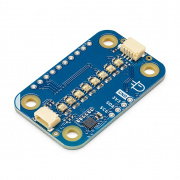
The Botland store offers highly functional modules from manufacturers such as SparkFun and Adafruit , thanks to which you will be able to build, among others: garden lighting, which can be turned on and off using an analog TEMT6000 light intensity sensor, which, if it detects a properly set "darkness" threshold, will send the necessary control signal to Arduino in order to start the lighting using a relay intermediating between the digital output of the microcontroller and the power grid. In turn, the TCS34725 color sensor based on classic RGB LEDs with an infrared filter will allow you to build an intelligent robot that recognizes a wide range of colors. The sensor module requires only four wires to connect to Arduino and can also be used as a color temperature meter.
Light and color sensors - FAQ
Color sensors most often send a beam of light towards the tested surface and then measure the parameters of the reflected electromagnetic radiation. By comparing them with saved patterns for various colors, they are able to determine the color of the surface.