










Membrane keyboards
Membrane keyboards are one of the most popular keyboard types today. They are comfortable to use, practical and inexpensive, and allow the use of waterproof and dustproof coatings, key backlighting and other useful functions. In this category you will find a wide selection of membrane keyboards from renowned manufacturers such as Waveshare and DFRobot. The products available in our shop can be used, for example, for programming single disc computers or in other electronic projects.
See also
- Zortrax Filaments
- Outdoor LED lighting
- Siemens LOGO!
- Esperanza compressed air
- 4-core cables
- Anet 3D printers
- Wireless mice
- DJI Mavic drones
- Syma drones
- Power supplies 12v 10a
- Fluorescent filament
- DJI Inspire drones
- 2-core cables
- Conductive paint
- 24v relays
- DJI Phantom drones
- Tablets
- Intel modules & kits
- Hexbug toys
- PLA Pro filaments
- DJI Mavic drones - drones and accessories
- Magnetic balls
- Compressed air to clean the keyboard
- Encoders
- Car fuses
- RPi Wi-Fi cards
- Odroid cases
- Intel starter kits
- Keyboards for Arduino
- Android Box Smart TV
- 2D printers and pens
- Banana Pi
- Raspberry Pi CM3
- Photo traps
- Headphones
- GPS trackers
- Resistors SMD 1206
- Smart ABS filaments
- Intel expansions & hats
- Odroid accessories
- Books about Raspberry Pi
- Chargers
- Vacuum forming
- STM32 books
- String bags (zip bags)
- Dobot 3D printers
- Intel - module accessories
- Photon
- AGM batteries
- BeagleBone power supply
- Car handles
- Refill filaments
- Electrolytic capacitors SMD
- BCN3D 3D printers
- Odroid
- Tantalum capacitors SMD
- Flsun 3D printers
- Sensors and alarms
- Alarm sirens
- Khadas VIM
- Arylic sound modules
- Laminators
- Zortrax 3D printers
- Doorbells and peepholes
- Motor capacitors
- RC cars and models
- Flexible filaments
- Trilab 3D printers
- Goofoo 3D printers
- Bluetooth Speakers
- Control equipment
- Linear actuators
- LED lighting
- Spare parts
- Webcams
- Urbicum 3D printers
- Mycusini 3D printers
- Weight meters
- ATMAT 3D printers
- Raspberry Pi 2B+
- TinkerGen
- Makeblock 3D printers
- DJI educational robots
- Orange Pi
- Fingerbot - home automation
- MakerPi 3D printers
- Transport cases
- Silk Filaments
- Sparky
- Abilix Krypton
- 3D printer Artillery
- Air conditioning and heating
- SkriWare - educational robots
- Gas soldering irons
- Air purifiers
- Exta Free - sensors and modules
- USB Numato Lab GPIO drivers
- LittleBits
- Netronix RFID modules
- Rock Pi
- Spresense Sony
- Clementoni
- AST lighting drivers
- CubieBoard
- WowWee
- Coolseer home automation
- AMK - automation and control
- Smartwatches
How does a membrane keypad work?
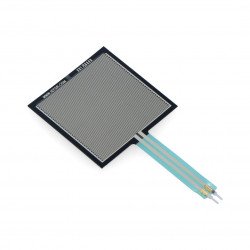
As with a traditional mechanical keyboard, pressing a button on a membrane keypad closes the electrical circuit and sends the appropriate signal to the control system. However, in this case, underneath the buttons, there are no independent switches recording the button press, but only a layer of special polycarbonate or polyester film with printed conductive paths, which is usually made by screen-printing from electrically conductive varnish (usually containing microscopic silver flakes). Similarly to the paths, the prints placed on the keyboard façade (external side visible to the user) are printed underneath the foil, so they do not wear off during use and make the whole look more aesthetic. Interestingly, despite the lack of such a need on the technical side, membrane keyboards can be equipped with extruded buttons, which increases the comfort of use (especially for people accustomed to using traditional mechanical keyboards or hybrid models).
Membrane keyboards - advantages
The main advantages of membrane keyboards include their resistance to various external factors. Since the individual keys do not have to be separated from each other, it is possible to create a product that is completely resistant to flooding and most chemicals, as well as dust, food crumbs or other contaminants. This also makes it easier to keep the keyboard clean, as in many cases it can be simply wet wiped off like other surfaces. The membrane keyboard is also very thin, so it takes up very little space and is ideal for projects or equipment where miniaturization of the components used is important. Such keyboards are very aesthetic and allow you to create buttons of virtually any shape, pattern and colour. Typical durability of this type of product is about ten to twenty million clicks. Membrane keyboards are also the cheapest of the types available on the market, which enables their wide application.
Application of membrane keyboards
Membrane keyboards are used in many applications - among others as peripheral accessories in computers and microcontrollers as control panels in measuring instruments or control buttons in microwaves, refrigerators, industrial machines and many other electronic devices. They are most often used in cases where it is necessary to limit the amount of space occupied by the keyboard (especially when it is to be as flat as possible). Membrane keyboards are also a good choice for applications requiring increased resistance to adverse external factors - moisture, dust, extreme temperatures or the presence of harmful chemicals. Therefore, they are used in circumstances where conditions are extremely difficult, for example in machines used in production halls in industrial plants or in laboratories and workshops.
What membrane keyboards can you find in Botland?
Our range includes a large selection of membrane keyboards from renowned manufacturers such as DFRobot and Waveshare. We offer models with different number of buttons (from one to twenty), which are designed to be used as monostable switches in electronic projects or interfaces for programming microcontrollers and single-board computers such as Arduino or Raspberry Pi. Some membrane keyboards available in this category are additionally equipped with a practical self-adhesive foil that makes it easy to mount in the desired position. In other sections of our shop you will also find a wide range of other types of keyboards and switches that can be used in creating various electronic designs.